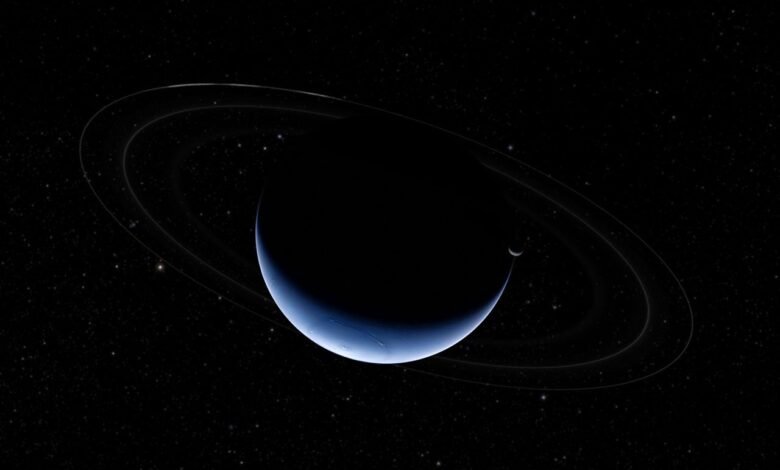
A newly highlighted composite image revisits the Voyager 2 flyby of Neptune, the only time a spacecraft has visited the most distant ice giant. The scene is built from pictures Voyager 2 recorded at its closest approach on August 25, 1989, and in the days afterward. It is an illustration assembled from spacecraft data, not a single photograph.
A view back toward the Sun
The composite places the viewer just beyond Neptune’s orbit, looking back toward the Sun, much as the outbound spacecraft would have seen the system. From that angle both Neptune and its largest moon, Triton, appear as thin, sunlit crescents against the dark sky.
Neptune’s south polar region shows several features. Cirrus clouds and a dark band encircle the pole, and a cloudy vortex sits above the pole itself.
Rings and background stars
The picture also includes Neptune’s faint ring system. Voyager first imaged parts of these rings during the flyby, along with the three bright ring arcs. The faintest segments were not captured directly and are modeled in the composite.
The stars behind the planet come from sky survey data rather than from Voyager. The starfield spans 7.5 degrees and is centered on the constellation Camelopardalis, matching the direction of the outbound spacecraft’s view of the Neptunian system.
Voyager 2 today
Voyager 2 is still operating in 2026 and is now in interstellar space. Its Neptune encounter in 1989 remains the only close-up reconnaissance of the planet, its moon Triton and its rings. The composite combines that single set of observations with modeled and survey-based elements to show how the system would have looked as the spacecraft departed.
Source: science.nasa.gov