The Legacy Survey of Space and Time (LSST), a 10-year project at the Vera C. Rubin Observatory in Chile, has officially begun after more than two decades of planning, construction, and testing. The survey is designed to produce a high-definition, time-lapse record of the southern sky, covering objects from the solar system to distant galaxies.
How the survey will work
The LSST relies on a 3.2-gigapixel digital camera, the largest in the world, mounted on the observatory’s 8.4-meter telescope. The camera will take about 1,000 images each night. On average, the survey will cover the entire southern sky every three to four nights throughout its decade-long run.
Repeated, regular coverage is the survey’s defining feature. Rather than producing a single static map, the LSST will build a record of how the sky changes over time.
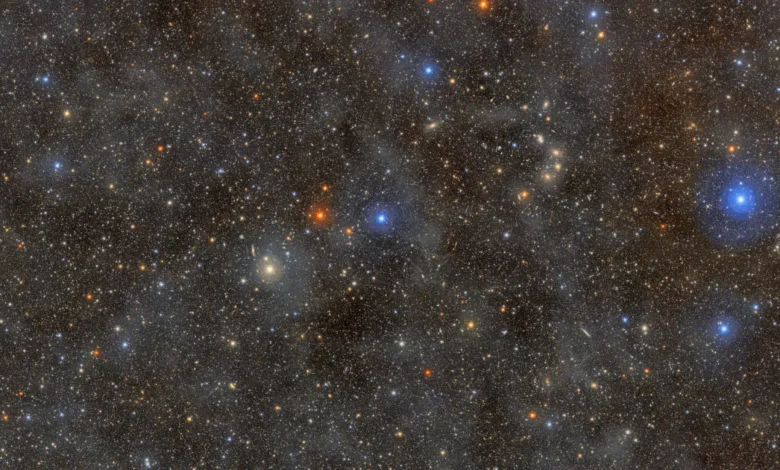
A wide-field view of galactic cirrus
Among the first images from the Rubin Observatory is a wide-field view of a region spanning roughly 1.7° by 1.7°. It is centered in the northeastern part of the constellation Centaurus, with its left side extending into neighboring Lupus.
Threaded across the frame are faint, wispy swirls of gas and dust known as galactic cirrus. These tenuous clouds are lit by the diffuse glow of the Milky Way, which makes them visible in deep, wide-field exposures like this one. The image also shows galaxies in the background. The observatory credits it to NSF–DOE Vera C. Rubin Observatory, NOIRLab, SLAC, and AURA.
The image comes from the observatory’s initial data, and it gives an early indication of the survey’s depth and field of view. The LSST itself is only starting its long observing campaign, and its scientific results will accumulate over the coming years.
Source: www.astronomy.com