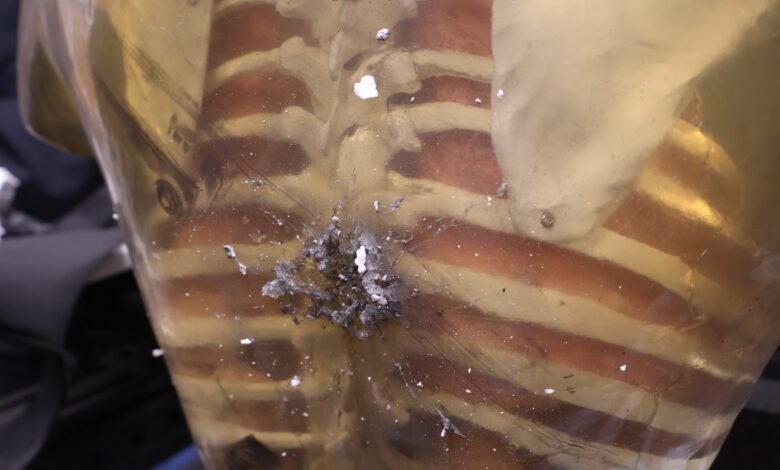
Atomic-6, a space startup that makes debris-shielding tiles for satellites, has published test results suggesting the same material could one day protect astronauts during spacewalks. In a hypervelocity impact test, a Space Armor tile stopped a projectile that went straight through a metal plate the company uses as a stand-in for current spacesuit protection.
What the test showed
The tests took place at Texas A&M University’s Hypervelocity Impact Laboratory. Atomic-6 fired a 3-mm aluminum sphere at about 7.2 km/s (roughly 16,100 mph) at a ballistic torso, first with a Space Armor Lite tile in front and then with a 4-mm-thick solid aluminum plate.
Behind the tile, the torso showed no visible damage or penetration. The back of the tile did not bulge, crack, or shed material. The aluminum plate was breached, and fragments lodged in the torso.
Atomic-6 stressed the limits of the experiment. A stationary ballistic torso is not a spacesuit, so the results say nothing about injury outcomes or whether a suit would keep its pressure after an impact. The company plans further tests with curved tiles and different impact angles, and it has begun early discussions with spacesuit makers about where armor could fit without restricting movement.
Two versions, under an inch thick
Space Armor comes in two versions. Space Armor Lite, the one tested, is designed to stop hypervelocity impacts from objects up to 3 mm in diameter. Space Armor Max targets objects up to 12.5 mm and is intended for human-rated spacecraft and habitats.
CEO Trevor Smith said the tiles are less than an inch thick. Traditional metal Whipple shields need 4 to 6 inches of standoff space, which makes them impractical for a suit. The tiles can also serve as a radome that lets radio-frequency signals pass to protect communications hardware. A second version blocks RF so signals cannot escape, at the same price and weight.
Flight test and a limit
A Space Armor Lite tile has already flown on Portal Space Systems’ Starburst-1 spacecraft, a flight meant to check that the material survives launch. It did. An actual debris strike on the tile is a different matter, since, as Smith noted, no one can arrange an impact in orbit.
The armor has a speed floor. Smith once shot a tile with a 9 mm Glock at a local gun range, and the bullet went through. He explained that the system works better the faster the projectile travels and begins to work at around Mach 10, a speed no 9 mm handgun can reach.
Smith told Payload that Atomic-6 built Space Armor to protect assets in orbit, and that no asset is more valuable than a human life. The suit-related results remain preliminary, with the curved-tile and angled-impact tests still to come.
Source: payloadspace.com