A proposed orbital experiment would deliberately blow up a spent Falcon 9 second stage while a group of small satellites filmed the event from close range. The aim is to fill a gap in the data used to model space debris. The concept comes from Michael Puckett, a regulatory compliance professional, who outlined it in a recent essay. It is not an announced mission, and the source gives no indication that SpaceX, NASA or any other agency has adopted it.
The gap in breakup data
Current breakup models draw on two kinds of evidence: laboratory impact tests and observations of accidental explosions and collisions in orbit. Lab tests let researchers recover and measure fragments. Orbital events happen under realistic conditions, but they are usually detected only after the debris cloud has formed. Neither approach has produced close, multi-angle observations of a complete upper stage breaking up in orbit.
NASA’s Standard Satellite Breakup Model estimates fragment size, area-to-mass ratio and separation velocity for explosions and collisions. Its outputs feed debris forecasts, conjunction assessments and shielding design. The explosion portion relies heavily on historical breakups. Those records are most complete for large objects, while fragments between one millimeter and ten centimeters are less well measured. That matters because small debris is far more numerous than cataloged debris and can still damage spacecraft.
What earlier tests showed
The DebriSat experiment, run by NASA’s Orbital Debris Program Office with the Air Force Space and Missile Systems Center, The Aerospace Corporation and the University of Florida, is the main modern laboratory effort. On April 15, 2014, a 570-gram aluminum projectile traveling about 6.8 kilometers per second struck a 56-kilogram satellite mock-up. The model had forecast roughly 85,000 fragments of two millimeters or larger. Researchers had collected more than 130,000 and expected about 250,000 after full characterization. The test also showed that composite structures produce many thin, flake-like and needle-like fragments, which spherical-particle assumptions represent poorly. DebriSat did not involve a full upper stage or an uncontained cloud in orbit.
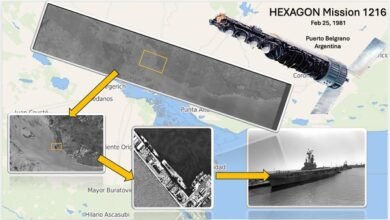
Delta 180, launched on September 5, 1986 by the Strategic Defense Initiative Organization, is the nearest orbital precedent. A maneuvering vehicle struck a Delta second stage head-on at about 2.9 kilometers per second, producing two debris clouds and at least 381 cataloged fragments of ten centimeters or larger. The observing spacecraft was also the impactor, so it was not available to watch the aftermath.
The proposed design
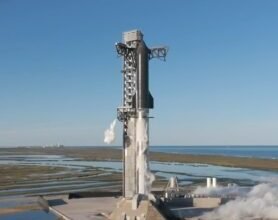
Puckett suggests using a Falcon 9 flight already scheduled to deliver a customer payload, perhaps a rideshare mission. Only after all payloads were deployed would the stage release four to six observer satellites into a very low orbit that decays within a few days. A command and timing package and an explosive charge on a composite overwrapped pressure vessel would trigger the breakup from a known location and energy state.
The observers would be inexpensive commercial-bus satellites carrying high-frame-rate and wide-field visible cameras, time synchronization, and position and attitude sensors. Some might also carry infrared cameras or particle-impact sensors. Their data would be compared with the NASA model’s prediction for a stage of the same mass. The experiment would measure fragment counts, size distribution, separation velocities, directional spread and cloud expansion, along with the gap between onboard and ground-based detection.
Orbit selection is a central issue. Atmospheric density varies with solar activity, and the longest-lived fragments, which may receive velocity changes that raise their orbits, set the limit. The 2008 USA 193 intercept at about 247 kilometers, after which all cataloged debris reentered in under a year, is offered only as an upper bound. A days-long limit would require a substantially lower orbit.
Safeguards
The plan conflicts with the US Government Orbital Debris Mitigation Standard Practices, which discourage intentional debris creation. Puckett argues approval should require independent review of predicted fragments, conjunction screening, exclusion of trajectories near crewed spacecraft, multiple command inhibits and coordination with tracking organizations. The breakup would be cancelled, and the stage disposed of normally, if the satellites failed to reach verified positions.
He proposes a possible follow-on in which a guided impactor would hit an upper stage to study collision debris.
Source: www.thespacereview.com