

Close Menu
Space Today
    Facebook X (Twitter) Instagram
    Space Today
    NEXT LAUNCHView upcoming space missionsExplore the Space Today launch schedule↗
    • Space News
    • Skywatching
    • Industry
    • Solar System
    • Technology
    • Astronomy & Universe
    • Spaceflight & Missions
    • Launches
    Space Today
    Home»Astronomy & Universe»Stars of different ages light up the same patch of southern sky
    Astronomy & Universe

    Stars of different ages light up the same patch of southern sky

    adminBy adminNovember 22, 2026No Comments2 Mins Read
    Share Facebook Twitter LinkedIn Email Telegram WhatsApp
    Stars of different ages light up the same patch of southern sky

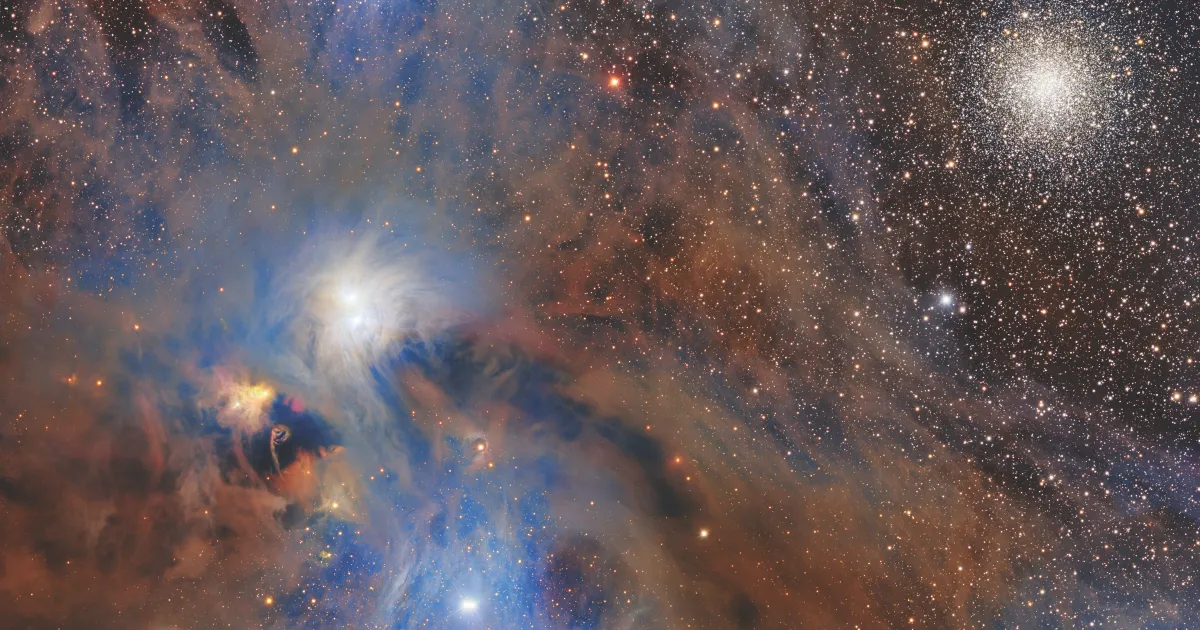
    An image credited to the Dark Energy Survey places two very different stellar populations in one field of view: a nearby cloud where stars are still forming, and a globular cluster that dates to the early history of the Milky Way. The scene sits at the northern edge of the constellation Corona Australis in the southern sky.

    The Corona Australis Molecular Cloud fills the left side of the frame with glowing gas and dark dust lanes. Most of the stars forming inside it are hidden by the surrounding material. One exception is R Coronae Australis, a variable star that shows through the cloud. It lies in an orange patch of dust to the lower left of the bright nebula that dominates the area just left of center. Several bluish reflection nebulae, which shine by scattering light from nearby stars, are scattered across the region. The image’s credited description identifies NGC 6726/6727 and NGC 6729 among them.

    The molecular cloud is about 430 light-years from Earth, which makes it one of the closest star-forming regions to the Solar System. It contains enough material to produce thousands of stars.

    A distant globular cluster in the same field

    The upper right corner shows a different kind of object. NGC 6723, known as the Chandelier Cluster, is a globular cluster that holds hundreds of thousands of stars. It is about 28,000 light-years away, roughly 65 times farther than the molecular cloud, and lies in far southern Sagittarius. The two objects share a line of sight but are not physically associated.

    The image credit lists the Dark Energy Survey, the U.S. Department of Energy, Fermilab, the Dark Energy Camera (DECam), Cerro Tololo Inter-American Observatory, NOIRLab, the National Science Foundation and AURA. The picture appears in the November 2026 issue of Astronomy magazine.

    Source: www.astronomy.com

    Share. Facebook Twitter LinkedIn Email Telegram WhatsApp

    Related Posts

    Sodium cloud surrounding Europa offers clues to its subsurface ocean

    November 25, 2026

    Modeling defines technical requirements for next-generation multi-object spectrographs

    November 24, 2026

    Dark Energy Camera images a nebula shaped like a betta fish

    November 24, 2026
    0 0 votes
    Article Rating
    Subscribe
    Notify of
    guest
    guest
    0 Comments
    Oldest
    Newest Most Voted
    Don't Miss

    NASA Science takes a closer look at Georgia’s pecan belt

    adminNovember 25, 2026

    SPHEREx observations peer through cosmic dust in new infrared view

    November 25, 2026

    Sodium cloud surrounding Europa offers clues to its subsurface ocean

    November 25, 2026

    Arianespace wraps up tenth Ariane 6 launch, with next mission set for Dec. 17

    November 25, 2026

    Space Today

    SpaceToday.com brings you the latest news in space exploration, astronomy, spaceflight, and scientific discoveries. From our solar system to the farthest reaches of the universe, we keep you informed and connected to the wonders of space.

    Facebook X (Twitter) Instagram
    Tourism
    • Outer Space Trip
    • your link here
    • your link here
    • your link here
    Featured Startups
    • your link here
    • your link here
    • your link here
    • your link here
    Links
    • Janet’s Planet
    • Space Launch Agency
    • Teachers In Space
    • your link here
    © 2026 - spacetoday.com - All rights reserved.
    • Space News
    • Upcoming Launches
    • Contact
    • Privacy Policy

    Type above and press Enter to search. Press Esc to cancel.

    wpDiscuz