


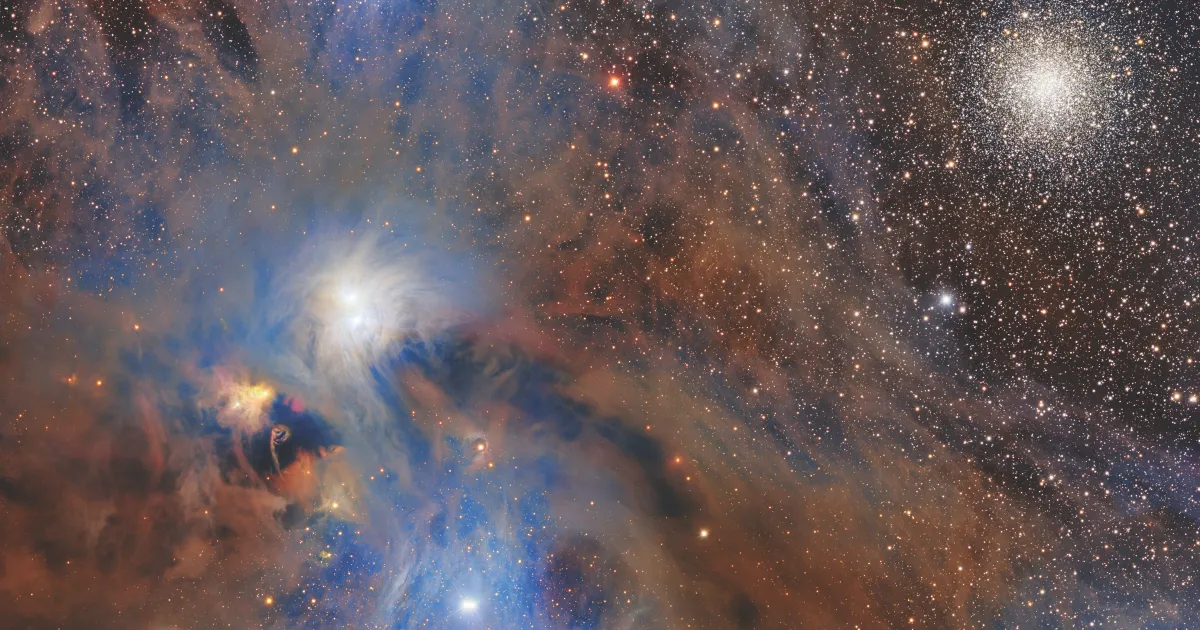
An image credited to the Dark Energy Survey places two very different stellar populations in one field of view: a nearby cloud where stars are still forming, and a globular cluster that dates to the early history of the Milky Way. The scene sits at the northern edge of the constellation Corona Australis in the southern sky.
The Corona Australis Molecular Cloud fills the left side of the frame with glowing gas and dark dust lanes. Most of the stars forming inside it are hidden by the surrounding material. One exception is R Coronae Australis, a variable star that shows through the cloud. It lies in an orange patch of dust to the lower left of the bright nebula that dominates the area just left of center. Several bluish reflection nebulae, which shine by scattering light from nearby stars, are scattered across the region. The image’s credited description identifies NGC 6726/6727 and NGC 6729 among them.
The molecular cloud is about 430 light-years from Earth, which makes it one of the closest star-forming regions to the Solar System. It contains enough material to produce thousands of stars.
A distant globular cluster in the same field
The upper right corner shows a different kind of object. NGC 6723, known as the Chandelier Cluster, is a globular cluster that holds hundreds of thousands of stars. It is about 28,000 light-years away, roughly 65 times farther than the molecular cloud, and lies in far southern Sagittarius. The two objects share a line of sight but are not physically associated.
The image credit lists the Dark Energy Survey, the U.S. Department of Energy, Fermilab, the Dark Energy Camera (DECam), Cerro Tololo Inter-American Observatory, NOIRLab, the National Science Foundation and AURA. The picture appears in the November 2026 issue of Astronomy magazine.
Source: www.astronomy.com