


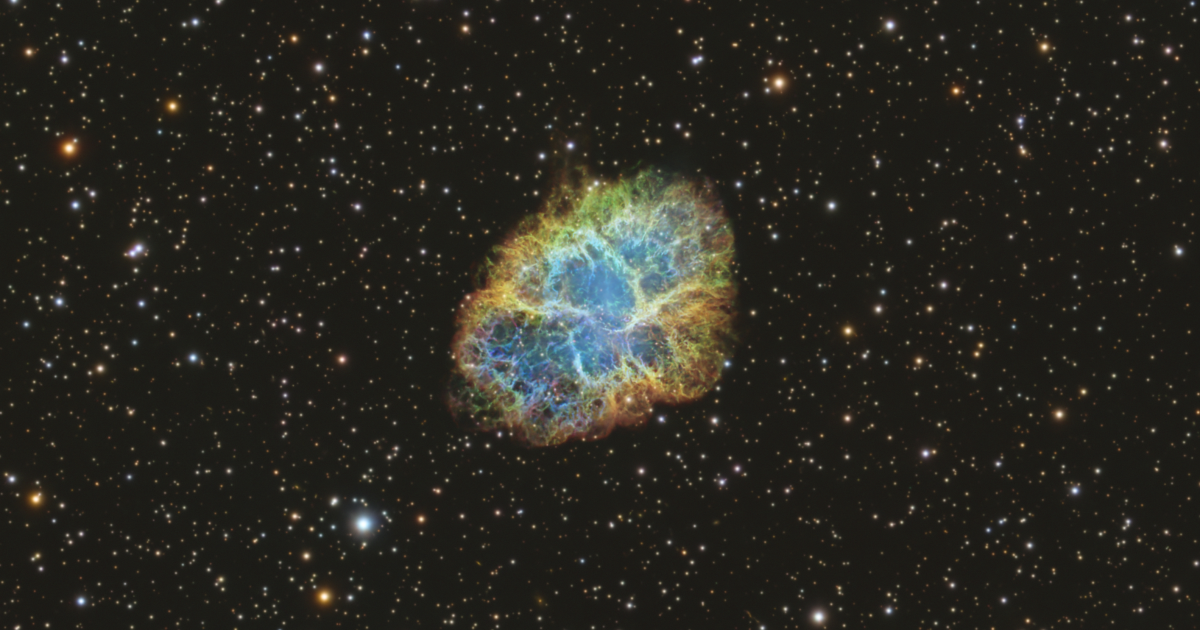
The Crab Nebula (M1) is a modest sight in the eyepiece but one of the most thoroughly studied objects in the sky, and it is well placed for observers now. Rising in the evening, it stays up all night. Astrophotographer and STEM outreach volunteer Molly Wakeling, who holds a Ph.D. in nuclear engineering, has highlighted the supernova remnant as a target for both visual observers and imagers.
A supernova seen in daylight
The nebula marks the death of a massive star in Taurus, which collapsed in a supernova in 1054 C.E. Its light was bright enough to be seen during the day, and multiple civilizations around the world recorded the event. The expanding shell of gas and dust is still visible, powered by what the star left behind: a rapidly spinning neutron star, or pulsar.
The nickname comes from a drawing made in the early 1840s by William Parsons, the Earl of Rosse, using a 36-inch telescope. His sketch showed crab-leg-like appendages. He later noted that views through a 72-inch instrument looked quite different from that original drawing.
The pulsar and its wind
The Crab Pulsar is only about 12 to 17 miles (20 to 28 kilometers) across, yet it rotates 30 times per second, once every 33 milliseconds. At magnitude 16.6, it is a difficult visual target. It is possible in scopes of 20 inches or more on nights of steady seeing, and a magnitude 15.8 star a few arcseconds away helps observers locate it.
The pulsar drives a stellar wind moving at relativistic speeds. Charged particles in the wind follow curved paths through strong magnetic fields and produce synchrotron radiation. That emission spans the electromagnetic spectrum from radio waves to gamma rays and forms the main diffuse glow of the nebula. Its total luminosity is roughly 100,000 times that of the Sun.
The wind also carries away energy, so the pulsar is gradually slowing. Its rotation period lengthens by 36 nanoseconds each day.
The nebula itself is still growing at about 3.4 million mph (5.5 million km/h), or 950 miles (1,527 km) per second, roughly 0.5% of the speed of light. A single observation will not show the change, but images taken several years apart reveal the expansion.
Imaging the filaments
Visually, M1 appears as a gray blob in most telescopes, or a spiky one in larger apertures. Photographs bring out the filamentary structure, which consists of the remnants of the progenitor star’s atmosphere. The gases include ionized helium, hydrogen, carbon, oxygen, nitrogen, iron, neon and sulfur.
Wakeling describes the Crab as moderately difficult to process. In wideband imaging, the interior is largely gray, wrapped in red tendrils. She says narrowband imaging works best for bringing out fine detail. Her wideband one-shot-color image used a 10-inch reflector and 11 hours of total exposure. Her narrowband version used a 9-inch reflector and 38.5 hours.
She colored the narrowband image to resemble the well-known 2005 Hubble Space Telescope view. That image assigns oxygen-III to red, sulfur-II to green and oxygen-I to blue. Because hydrogen-alpha has a wavelength similar to oxygen-I, she used it as the blue channel.
For visual observers, the main questions are how much structure a given telescope can show and whether the pulsar can be glimpsed at all.
Source: www.astronomy.com