


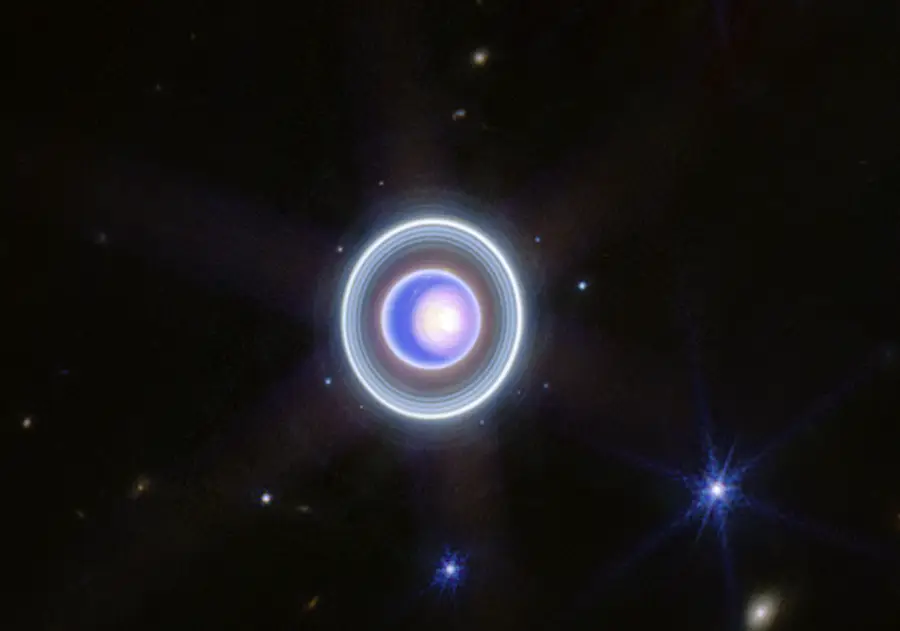
Uranus reaches opposition on November 25, 2026, putting the seventh planet opposite the Sun in Earth’s sky and giving observers one of the best views of the year. The ice giant lies about 2.8 billion km (1.7 billion miles) from Earth, roughly 2.6 light-hours away. It shines at magnitude 5.6, bright enough to be a naked-eye target under dark skies.
Finding Uranus in Taurus
Uranus currently sits in Taurus, midway between the Pleiades and Hyades clusters. From a Bortle 5 suburban sky, where the limiting magnitude runs between 5.6 and 6.0, spotting it unaided is feasible but demanding. Rural skies make it easier. The waning gibbous Moon leaves the evening sky from November 27, which clears the way for observing.
At a declination of +21°, the planet climbs to about 70° altitude at midnight for observers at latitude 40° north. The 4th-magnitude star 37 Tauri serves as a guide. From the Pleiades, move 4.5° southeast to reach the star, then look 1.5° due south. No similarly bright stars nearby should cause confusion. Averted vision, which means letting the eyes wander around the target instead of staring at it, helps, and binoculars can confirm the identification.
Uranus is moving westward in retrograde motion through fall and early winter. It resumes eastward motion on February 8, 2027. Smart-telescope users can photograph it weekly and stack the frames to trace its path against the background stars.
What telescopes show
The planet’s disk is about 3.8″ wide. Bob King, who wrote the observing guide, reports that it becomes detectable at 86× in a 15-inch Dobsonian and obvious at 245×. He sees a yellowish disk, while others report cyan or pale aqua. He has not distinguished surface detail himself, though skilled amateurs have occasionally recorded bands and spots. Large storms in August 2014, and again in September and October of that year, were imaged by amateur astrophotographers including Marc Delcroix and Anthony Wesley.
Titania (magnitude 13.8) and Oberon (14.0), the two brightest moons, are reachable with an 8-inch scope in good seeing. Because Uranus currently presents its north pole toward Earth, the moons circle it like clock hands instead of shifting side to side. At maximum elongation Titania lies about 30″ from the planet and Oberon about 42″. Both will be near maximum elongation around 11 p.m. CST on December 2. Ariel (14.2) has been seen in a 24-inch telescope, while Umbriel (14.9) and Miranda (16.4) sit closer to the planet and are harder. Miranda would likely need an aperture of at least 32 inches visually, though astro-imagers have captured all five moons in scopes as small as 9 inches.
Context for public observing
Uranus passed aphelion in 2009 and is now inbound toward perihelion in 2050. William Herschel discovered it on March 13, 1781, using a 6.2-inch reflector, when it lay in eastern Taurus near the star 1 Geminorum. It returns to that spot in late June 2032, only the third time since the discovery.
For outreach sessions, the planet has plenty to offer. Its axial tilt of 97.8° makes it the only planet that spins nearly on its side. Like Venus, it rotates opposite to most planets, clockwise as seen from above the solar system plane. Uranus has 29 known moons and 13 rings, and each pole gets 42 years of sunlight followed by 42 years of darkness over its 84-year orbit. It emits little internal heat, and its cloud tops measure −224°C (−371°F), making it the coldest planet in the solar system.
Hubble recorded auroras high in the Uranian atmosphere in October 2022, in ultraviolet and visible light. They lie near the magnetic poles, and the planet’s magnetic axis is tilted 59° from its rotational axis and offset from the planet’s center by a third of its radius.
Observers can build a planetary tour this season: Mercury and Venus at dawn, Mars and Jupiter in the small hours, and Saturn at dusk. From Saturn, Uranus is the next stop outbound, followed by Neptune, which lies 6.5° west-southwest of Saturn.
Source: skyandtelescope.org