


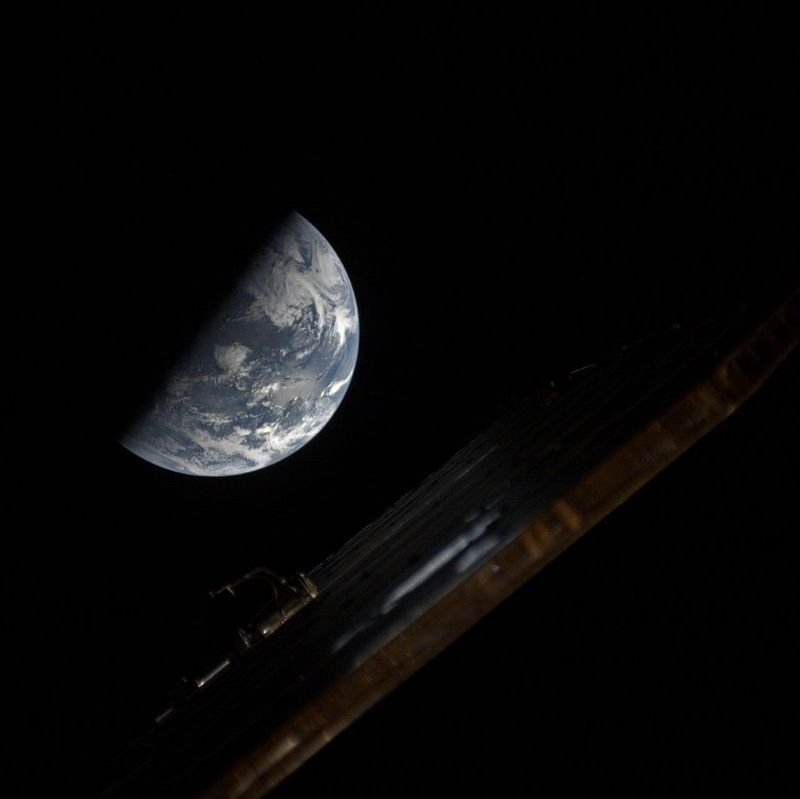
NASA’s ESCAPADE mission has completed its Earth flyby and is now on course for Mars. The Gold spacecraft, one of two identical probes in the mission, turned to photograph Earth about three hours after its closest approach on November 9, 2026. At that point it was roughly 38,500 miles (62,000 km) away, about six times closer than the Moon. A sliver of the probe’s own solar panels is visible at the bottom of the frame.
A gravity assist on the way to Mars
The flyby was a gravity assist. It corrected the trajectory of the spacecraft and gave the probes, each about the size of a mini-fridge, an additional boost in speed. The twin spacecraft, Blue and Gold, each made their own pass: one on November 7 and the other on November 9, 2026. They are due to reach Mars on September 7 and 9, 2027.
ESCAPADE, short for Escape and Plasma Acceleration and Dynamics Explorers, launched on November 13, 2025, aboard Blue Origin’s New Glenn rocket from Launch Complex 36 at Cape Canaveral Space Force Station in Florida. It was only the second flight of the heavy-lift vehicle, following its debut in January 2025. The reusable first-stage booster returned and landed safely on a platform.
Studying a hybrid magnetic environment
Mars has no global magnetic field like Earth’s, which is generated by a convecting molten iron core and forms a magnetosphere that shields the planet from the solar wind. Mars apparently had such a field billions of years ago. As a smaller, colder planet, it cooled, its core dynamo shut down and the global field collapsed.
Iron-bearing rocks that solidified while the field was active retained their magnetization. Those patches of crust still produce localized magnetic fields, some of them surprisingly strong, especially in the southern highlands.
The result is a hybrid system. Like Venus, Mars has a magnetosphere induced in part by the solar wind interacting with its atmosphere. It also has regions of intrinsic crustal magnetism, along with larger-scale global influences.
ESCAPADE’s two orbiters will take simultaneous measurements from different locations, letting scientists watch how this environment responds in real time as the solar wind hits it. NASA says the mission will analyze how the magnetic field guides particle flows around the planet, how energy and momentum move from the solar wind through the magnetic environment, and what controls the flow of energy and matter into and out of the Martian atmosphere.
Scientists expect the results to clarify how Mars lost most of its atmosphere and its magnetosphere over time. That bears on a larger question: whether Mars was once habitable, and whether it could be again.
A low-cost mission
The mission design is led by UC Berkeley. The Blue and Gold spacecraft, named for the university’s colors, cost under $80 million combined, roughly 10% of what a typical Mars mission costs.
Source: earthsky.org