


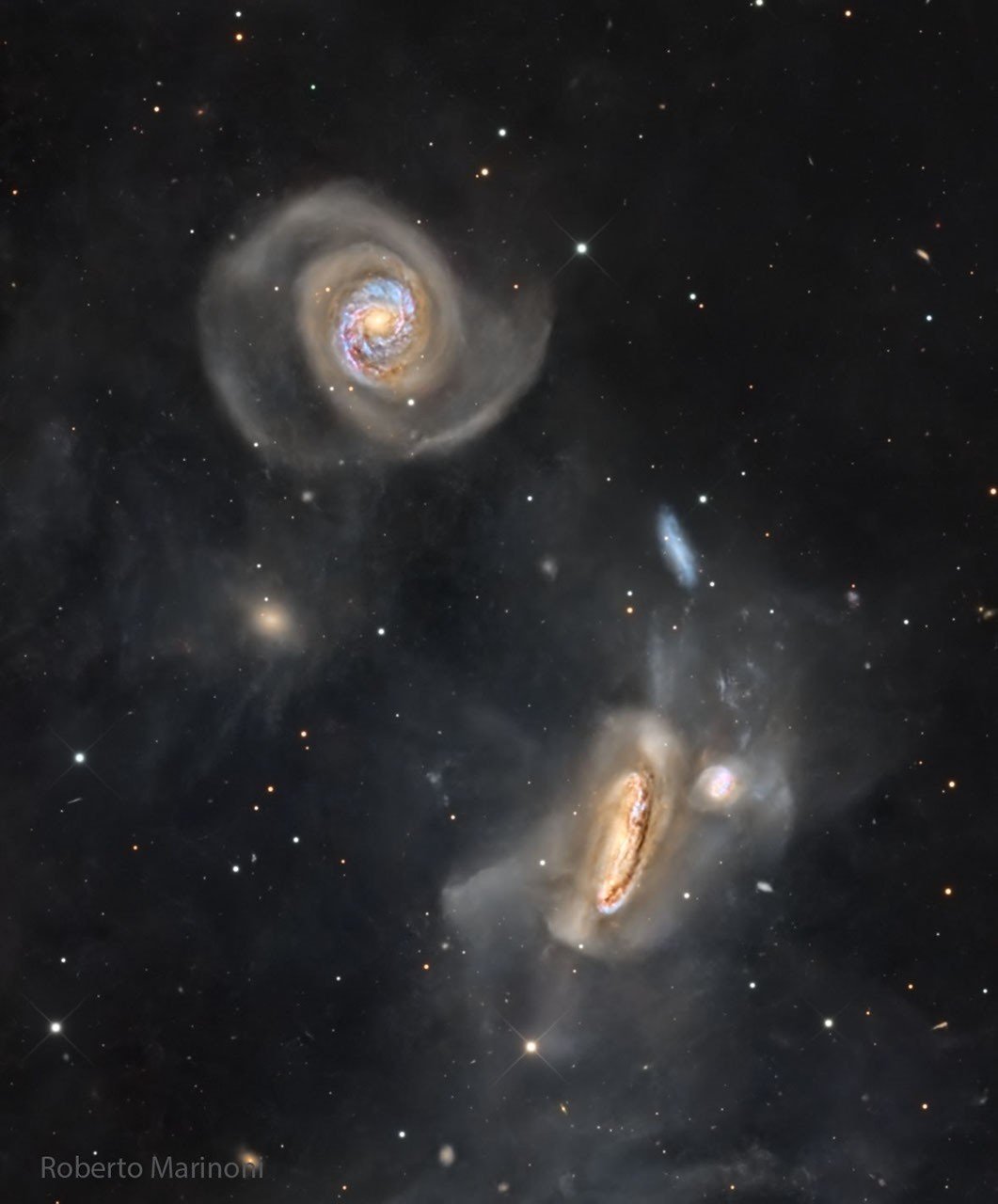
A cluster of interacting galaxies in the constellation Pegasus is on course to merge into a single, much larger system. The group, known as the NGC 7771 Group, lies almost 200 million light-years from Earth. Its members have already been pulled out of shape by earlier gravitational encounters. The process is expected to continue over billions of years.
A group already showing the marks of past encounters
Rings and faint swirls of stars are visible in the featured image of the group. They are the remnants of previous close passages, in which each galaxy’s gravity disturbed the stars of its neighbors.
The largest member is NGC 7771, a barred spiral galaxy at the lower right of the frame, which measures about 75,000 light-years across. At the upper left is NGC 7769, a spiral galaxy that is almost as large. Several smaller galaxies belong to the group as well.
Repeated passages, one eventual galaxy
As these galaxies continue to make close passes around one another, they are expected to coalesce into one very large galaxy. This outcome is a projection based on current understanding of galaxy dynamics, not an observed event. The merger would unfold over billions of years.
Astronomers regard such mergers as a normal part of galaxy evolution rather than an unusual occurrence. Galaxies grow and change shape through repeated gravitational interactions, and groups like this one show the process at an intermediate stage.
Relevance to the Milky Way
Studying galaxy collisions of this kind also bears on the future of our own galaxy. The Milky Way and the Andromeda galaxy may eventually merge, and observations of systems such as the NGC 7771 Group help researchers better understand how that kind of encounter could play out.
Source: science.nasa.gov