


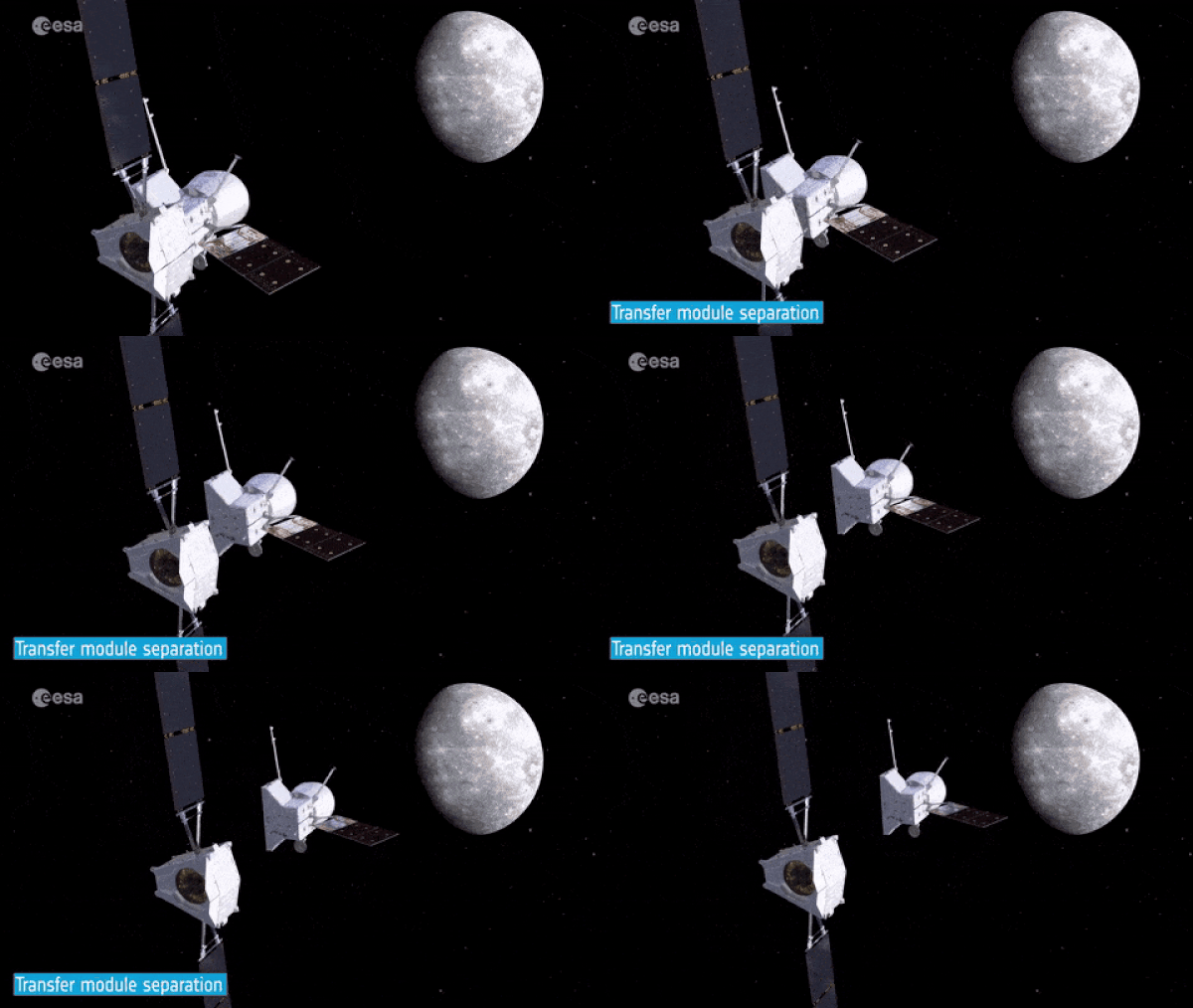
The European Space Agency’s BepiColombo mission has achieved orbital capture around Mercury, ESA Operations announced on November 21, 2026, closing an eight-year journey through the inner solar system. The joint ESA and Japan Aerospace Exploration Agency (JAXA) mission is expected to give scientists their first close-up view of the planet since NASA’s MESSENGER ended its mission in 2015. MESSENGER was the first and, until now, only spacecraft to orbit Mercury.
ESA said the spacecraft is back in contact with ground controllers and that teams at the European Space Operations Centre (ESOC) are analyzing its telemetry. Flight Dynamics specialists had already confirmed the capture. ESA said the next update, covering upcoming steps, would follow early the following week. The insertion burn had been scheduled for 19:24 CET (18:24 UTC).
Why reaching Mercury takes so long
BepiColombo launched from Kourou, French Guiana, on October 20, 2018. Mercury is hard to reach because a spacecraft falling toward the sun gains speed, and it must shed that speed to be captured by a small planet rather than fly past it.
The mission used gravity-assist flybys to slow down: one of Earth, two of Venus and six of Mercury itself. The sequence ran as follows:
- April 10, 2020: Earth
- October 15, 2020, and August 10, 2021: Venus
- October 1, 2021; June 23, 2022; June 20, 2023; September 4, 2024; December 1, 2024; and January 8, 2025: Mercury
Two orbiters, one more separation
BepiColombo consists of two science spacecraft, the Mercury Planetary Orbiter and the Mercury Magnetospheric Orbiter. They traveled together with a Mercury Transfer Module, the propulsion unit that carried them through the cruise. ESA reported that the module separated from the orbiters on September 3, 2026, a necessary step before they could enter orbit this close to the sun.
The two orbiters remain joined and will separate from each other on December 9–10, 2026. Science operations are scheduled to begin in April 2027.
Questions BepiColombo is meant to answer
Mercury is the least-understood planet of the inner solar system. Before BepiColombo, only NASA’s Mariner 10 and MESSENGER had visited it. Scientists hope the mission will address five open questions:
- Where Mercury came from
- Whether there is water on the planet
- Whether Mercury is geologically active
- Why its surface is so dark
- Why it has a magnetic field
The orbiters will spend at least one year at Mercury. High-resolution instruments will study the mineral and elemental composition of the surface, and the polar regions will be scanned for ice. Researchers will also look for surface features that have changed since MESSENGER’s visit about a decade ago. Because the two orbiters will pass through different regions of Mercury’s magnetosphere, they should show how it changes and how it interacts with the sun.
ESA Operations is posting mission updates on Bluesky.
Source: earthsky.org