

Close Menu
Space Today
    Facebook X (Twitter) Instagram
    Space Today
    NEXT LAUNCHView upcoming space missionsExplore the Space Today launch schedule↗
    • Space News
    • Skywatching
    • Industry
    • Solar System
    • Technology
    • Astronomy & Universe
    • Spaceflight & Missions
    • Launches
    Space Today
    Home»Skywatching»SPHEREx observations peer through cosmic dust in new infrared view
    Skywatching

    SPHEREx observations peer through cosmic dust in new infrared view

    adminBy adminNovember 25, 2026No Comments2 Mins Read
    Share Facebook Twitter LinkedIn Email Telegram WhatsApp
    SPHEREx observations peer through cosmic dust in new infrared view

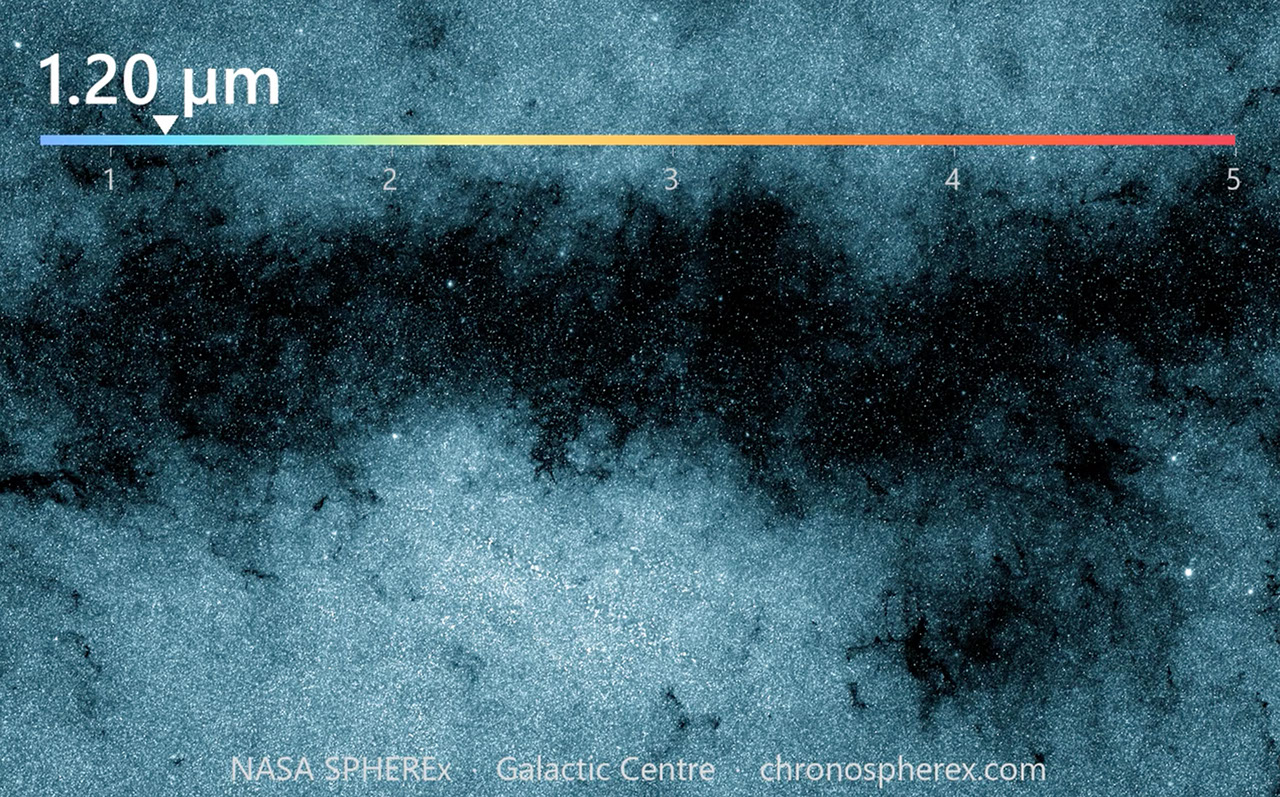
    NASA’s SPHEREx satellite has captured a wavelength-by-wavelength view of the center of the Milky Way, showing how the galaxy’s dust hides the Galactic Center at some infrared wavelengths and lets it show through at others. The images were assembled into a video in which each false color represents the infrared wavelength labeled in the upper left corner.

    Why the Galactic Center disappears and reappears

    The effect comes from interstellar dust. In near-infrared light, such as 1.2 microns, dust particles absorb and scatter incoming light. At those wavelengths SPHEREx sees the Galactic Center almost completely obscured by dust clouds. At mid-infrared wavelengths, light passes through the dust and reaches the spacecraft’s detectors, so the central region becomes visible.

    The explanation notes that this resembles, but is not identical to, the reason sunsets look red. In both cases, the amount of light that gets through a dusty or particle-filled medium depends on its wavelength.

    What the dust is made of

    The Milky Way has been accumulating dust for about 13 billion years. Cosmic dust differs from household dust, which consists of skin cells, dirt, pollen and other debris. Cosmic grains are hundreds of times smaller and are composed of tiny compounds of oxygen, carbon and other elements. These materials are released into space when a star dies.

    Because the dust is a product of stellar death accumulated over the galaxy’s history, it now forms a substantial barrier along many lines of sight toward the galaxy’s core. Observing at several infrared wavelengths shows which parts of the spectrum are blocked and which can reach an observer.

    The material describes the video as showing infrared light gathered by SPHEREx. It does not give details of the satellite’s instruments, observing dates or any new scientific results from the observations.

    Source: science.nasa.gov

    Share. Facebook Twitter LinkedIn Email Telegram WhatsApp

    Related Posts

    ESCAPADE spacecraft photographs Earth while en route to Mars

    November 24, 2026

    NGC 7771 galaxy group shows interacting galaxies in a cosmic clash

    November 24, 2026

    BepiColombo reaches Mercury orbit on November 21

    November 23, 2026
    0 0 votes
    Article Rating
    Subscribe
    Notify of
    guest
    guest
    0 Comments
    Oldest
    Newest Most Voted
    Don't Miss

    NASA Science takes a closer look at Georgia’s pecan belt

    adminNovember 25, 2026

    SPHEREx observations peer through cosmic dust in new infrared view

    November 25, 2026

    Sodium cloud surrounding Europa offers clues to its subsurface ocean

    November 25, 2026

    Arianespace wraps up tenth Ariane 6 launch, with next mission set for Dec. 17

    November 25, 2026

    Space Today

    SpaceToday.com brings you the latest news in space exploration, astronomy, spaceflight, and scientific discoveries. From our solar system to the farthest reaches of the universe, we keep you informed and connected to the wonders of space.

    Facebook X (Twitter) Instagram
    Tourism
    • Outer Space Trip
    • your link here
    • your link here
    • your link here
    Featured Startups
    • your link here
    • your link here
    • your link here
    • your link here
    Links
    • Janet’s Planet
    • Space Launch Agency
    • your link here
    • your link here
    © 2026 - spacetoday.com - All rights reserved.
    • Space News
    • Upcoming Launches
    • Contact
    • Privacy Policy

    Type above and press Enter to search. Press Esc to cancel.

    wpDiscuz