


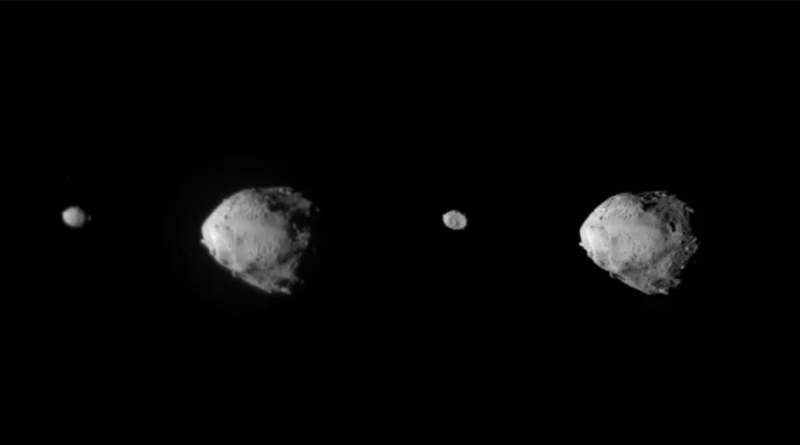
The European Space Agency has released the first close-up images of what NASA’s DART spacecraft did to the asteroid Dimorphos in 2022. The pictures, taken by ESA’s Hera spacecraft and published on November 25, 2026, show a crater about the size of a sports stadium with a central peak. They also reveal that the asteroid is behaving in ways researchers did not anticipate.
A flattened face and a tumbling moonlet
Dimorphos is the small moonlet that orbits the larger asteroid Didymos. According to Hera principal investigator Patrick Michel, the side struck by DART has been flattened into a crater that spans the asteroid’s entire width. Hera mission scientist Michael Kueppers said that as more images came in, it became clear the impact left Dimorphos tumbling erratically in its orbit.
Hera also found hundreds of boulders, each only a few meters across, orbiting both asteroids. Kueppers said the team will have to account for these objects in the coming weeks as the spacecraft moves closer to take higher-resolution images.
Eclipse and first views
Earlier in the week, ESA shared an image showing Dimorphos casting a rounded shadow across Didymos, a solar eclipse on an asteroid. The Sun lies outside the frame, aligned with the two bodies. ESA also released a view of Dimorphos completing a full orbit around Didymos, with the impact site coming into view.
Hera’s first look at the system came on November 5, when the spacecraft was about 37 miles (60 km) from Didymos. That image showed a side of Didymos DART’s camera never saw before impact. Michel said it keeps the central equatorial ridge seen earlier but otherwise looks quite different, with multiple boulders, craters and what appear to be grooves or ridges. Kueppers suggested some of those features could come from material blasted off Dimorphos and carried across the roughly 0.6 miles (1 km) separating the two bodies. Sorting that out is part of the work ahead.
What Hera is there to do
DART, the first planetary defense test, struck and moved an asteroid. Hera launched on October 7, 2024, to establish the details. Over six months it will measure how much the impact changed Dimorphos’s orbit and examine the physical structure of both asteroids. The mission is expected to land on the asteroid during its investigation. ESA has described the effort as a “crime scene investigation.”
Hera is scheduled to release two CubeSats in January 2027. Milani will study the surfaces of both bodies by analyzing reflected light. Juventas will use radar to probe the interior of Dimorphos, which would provide the first radar soundings inside an asteroid.
ESA has outlined three questions the mission should help answer:
- Whether Dimorphos is a rubble pile held together loosely by gravity or a solid core covered in boulders and gravel. Hera will measure its density and composition.
- How the surface responded to the collision. Hera will map the crater at a resolution of 4 inches (10 cm). ESA notes the impact may have reshaped the whole asteroid rather than simply digging a crater.
- How binary asteroids form. About 15% of known asteroids are binary systems, and their origins are unclear. If Dimorphos and Didymos share the same material, that would suggest the rapidly spinning Didymos shed debris that later formed its companion.
Dimorphos is about 560 feet (170 meters) across, and Didymos is roughly half a mile (800 meters) wide.
Source: earthsky.org