


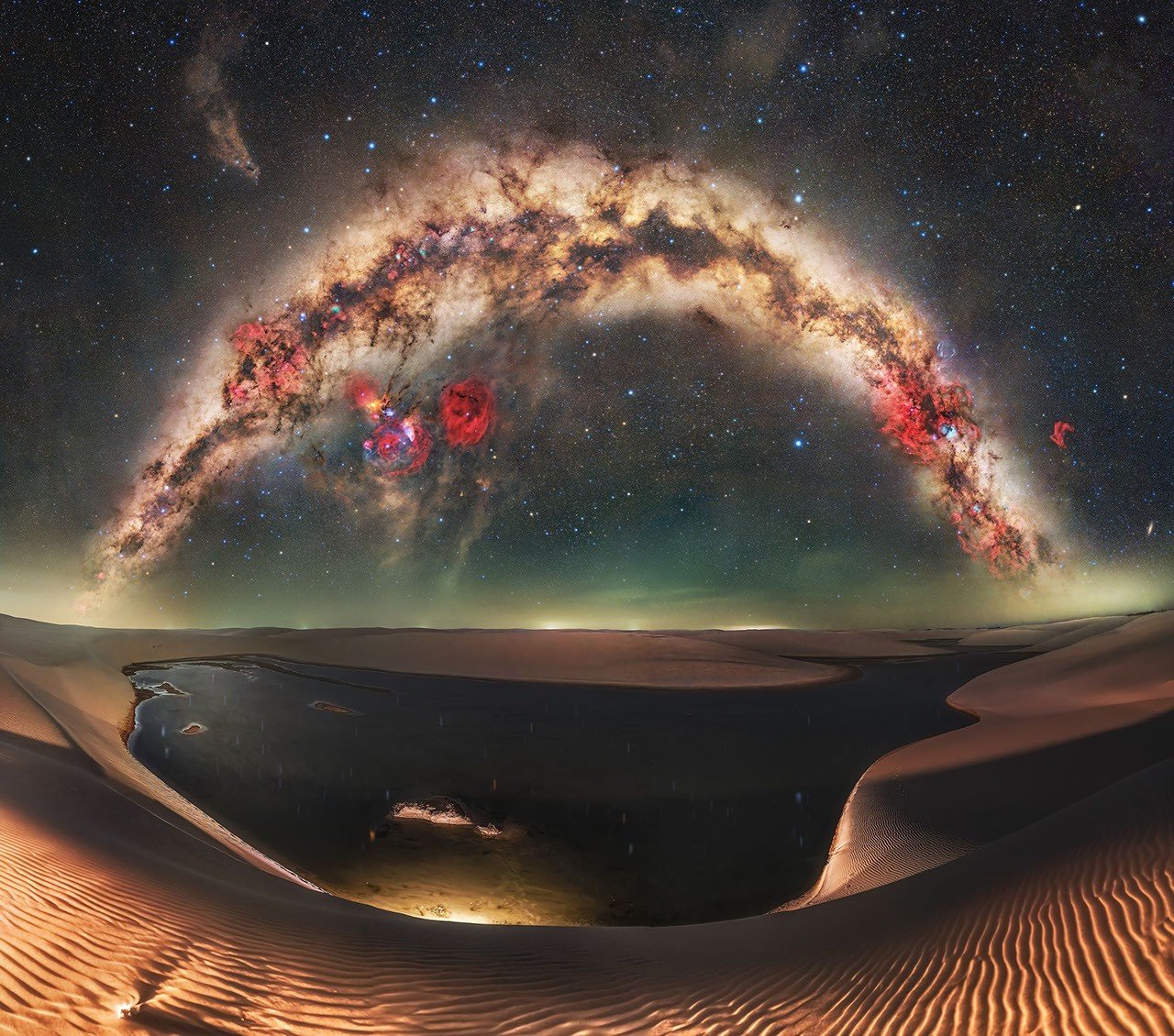
A composite photograph of the Milky Way over Brazil’s Lençóis Maranhenses National Park has been featured as an astronomy image of the day. It shows the Galaxy arching above white sand dunes and dark lagoons, and the framing produces what looks like an eye, half in the sky and half on the ground.
The image was taken in July, late in the night, from a latitude of roughly 2° south. It is a composite, so it combines more than one exposure. The Milky Way’s prominent structure is visible, including dark dust lanes and colorful nebulas.
Why the Milky Way looks like an arch
The arc across the sky is not real. The curved shape is an artifact of the wide-angle lens used for the shot, which stretches and bends the apparent geometry of a very wide field of view. The Galaxy does not actually form a rainbow-like bow overhead.
The photographer positioned the Milky Way so that its curve follows the outline of the dark lagoon below. Together the two shapes create the illusion of an eye, with the lagoon forming the lower half and the Galaxy the upper.
A changing view through the night and year
Which part of the Milky Way is visible depends on the time of night and the time of year. The Galaxy appears to rotate across the sky every night, and the view shifts again over the course of the year. Taking the image late in the night in July determined which regions of the Galaxy appear in the frame.
Lençóis Maranhenses National Park, on the northern coast of Brazil, is known for its white dunes and the dark lagoons between them. The scene’s contrast between pale sand, dark water and the star-dense band of the Galaxy is what lets the lagoon and the Milky Way line up into the eye-like shape.
The picture is an example of how lens choice and composition can change the look of a familiar astronomical subject, even though the underlying features it records, dust lanes and nebulas, are real.
Source: science.nasa.gov