


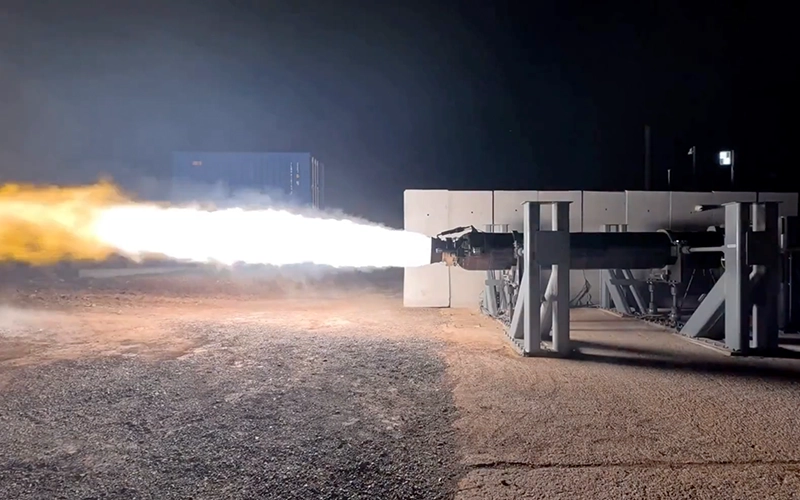
German launch company HyImpulse has completed the first hot-fire test of its HyPLOX-90 hybrid rocket motor with a thrust vector control (TVC) system installed, a step forward for the development of its SL1 orbital launch vehicle.
The company announced the result in a 27 November update. It told European Spaceflight that the test took place on 16 November at a new test site in the “Mediterranean region.” HyImpulse did not name the exact location.
What the test added
The 90-kilonewton HyPLOX-90 burns paraffin wax with liquid oxygen. HyImpulse first fired the motor in an initial hot-fire test in 2024. That test and other earlier firings did not include a thrust vector control system, which makes the 16 November test the first with the hardware in the loop.
TVC lets a rocket steer during powered flight by changing the direction of the thrust its motors produce. The SL1 will need that capability to fly a controlled ascent to orbit.
SL1 and its schedule
SL1 is a three-stage rocket designed to carry payloads of up to 600 kilograms to low Earth orbit, and the HyPLOX-90 is intended to power it. HyImpulse’s most recent official statement naming a target year for the first flight was published on 16 October 2025. It said the vehicle was expected to begin delivering payloads to orbit in 2027.
Asked by European Spaceflight for an updated timeline for integrated testing and the inaugural flight, the company declined to give dates. It said it is continuing preparations for the first launch, with work under way on regulatory, operational and launch campaign activities alongside its partners. It added that further details will be released once available.
SR75 suborbital rocket
HyImpulse has also developed a smaller suborbital vehicle, the SR75, which made its debut on 3 May 2024 from the Koonibba Test Range in South Australia. A second SR75 flight had been expected in late 2026. In October, the company said that mission, to be launched from SaxaVord Spaceport in Scotland, had slipped to spring 2027.
Source: europeanspaceflight.com