


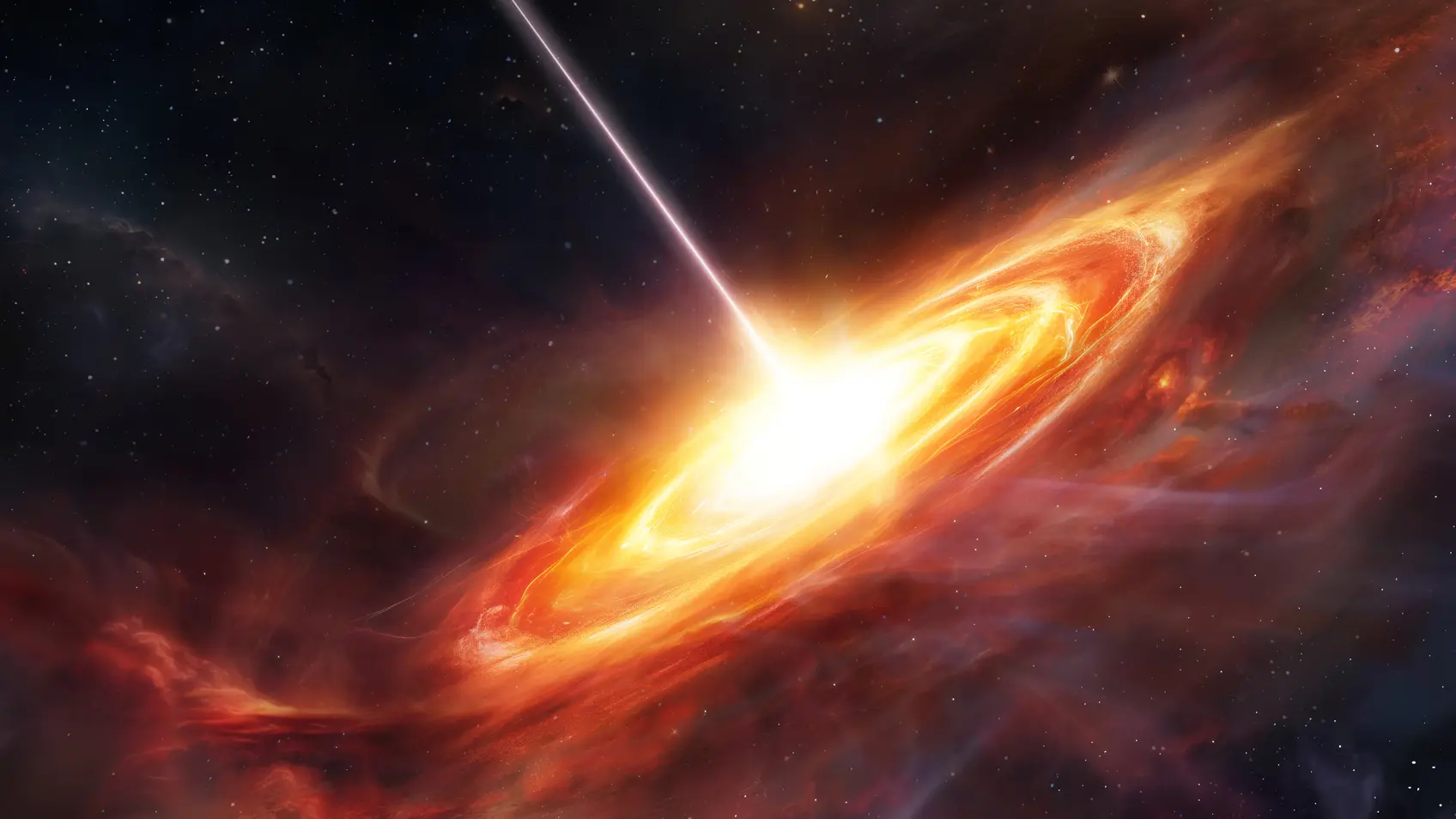
A quasar powered by a black hole of hundreds of millions of solar masses already existed just 630 million years after the Big Bang, according to a team using data from the European Space Agency’s Euclid mission. The object, now the most distant quasar known, sits at a redshift of 8.13, about 40 million years further back in cosmic time than the previous record-holder. Its existence sharpens a long-standing question about how black holes grew so massive so quickly.
A record found in Euclid data
The team was led by Julien Wolf of the Max-Planck-Institute for Astronomy in Germany. They identified the quasar in preliminary Euclid data. Euclid is a space observatory designed to map one-third of the sky and detect billions of galaxies out to 10 billion light-years. This quasar lies well beyond that distance.
Formally designated J1504+6252, the object has also been nicknamed Dún Aonghasa, after a prehistoric stone fort on Inis Mor, off Ireland’s west coast. The fort overlooks the open ocean, and the researchers chose the name because the quasar sits at the current edge of observation.
After flagging the candidate, the researchers followed up with the Hubble and Webb space telescopes, the Large Binocular Telescope Observatory in Arizona and the W. M. Keck Observatory in Hawai‘i. The results appear in Astronomy & Astrophysics.
Team member Xiaohui Fan of Steward Observatory notes that high-redshift quasars are extremely rare. Finding them requires wide, deep sky surveys for selection, plus large ground- or space-based telescopes to confirm them spectroscopically. Fan said astronomers had expected Euclid to be the first survey to turn up a quasar beyond redshift 8, and that the discovery bears this out.
What the observations show
Follow-up images revealed luminous blue light, characteristic of the gas disks that spiral into the supermassive black holes powering quasars. The object is brighter and bluer than most of the “Little Red Dots” found in Webb data. Those objects may represent an earlier phase in which newly formed black holes are enshrouded in gas and feeding on it.
The spectra also display broad emission lines, produced by gas clouds moving in tight orbits around the black hole, another defining quasar feature. The team used these lines to establish the redshift and, from the gas motions, to estimate the black hole’s mass at between 200 million and 800 million solar masses. Despite that size, the black hole is not accreting gas as quickly as astronomers might have expected.
Where did the black hole come from?
Other distant quasars with several hundred million solar masses have been found before, but this one raises the problem in sharper form: how does a black hole reach such proportions within a few hundred million years, particularly if it grows at a modest rate?
One possibility is that it began as the remnant of a relatively ordinary star of about 100 solar masses. That route would require very rapid feeding early on to reach the present mass. A more likely explanation, according to the discussion in the study, is a heavier seed. In the early universe, huge clouds of pristine gas may have collapsed directly into black holes without passing through a stellar phase. Such black holes could start at around 100,000 solar masses and then grow at moderate rates.
Fan thinks direct collapse is likely for this object, but cautions that it does not mean all quasar black holes formed that way. He said multiple formation and growth pathways probably exist.
The record may not stand for long. Fan said the team’s model predicts that Euclid and the Nancy Grace Roman Space Telescope could find luminous quasars out to a redshift of about 10, provided quasar evolution continues to follow the trend seen so far.
Source: skyandtelescope.org