


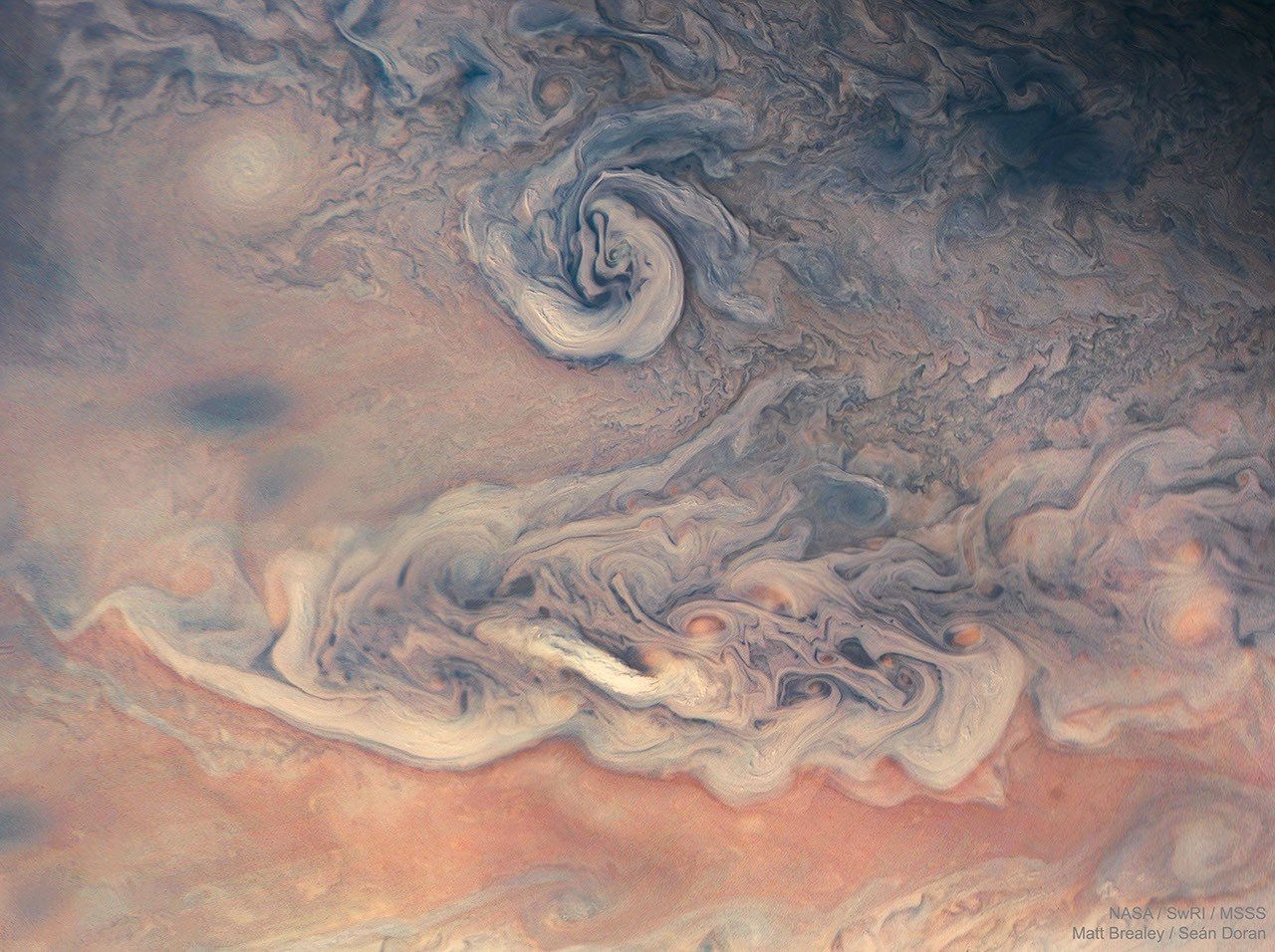
The colors that streak and swirl through Jupiter’s clouds remain an open scientific question, even after years of close-range imaging by NASA’s Juno spacecraft. A color-enhanced image from the probe’s 14th low pass over the planet, taken in 2018, illustrates both what researchers can see and what they still cannot explain.
Jupiter’s thick atmosphere is made up mostly of hydrogen and helium. At the cold temperatures found at the Jovian cloud tops, both gases are colorless, so they cannot account for the reds, browns and whites visible in images of the planet. The tint must come from trace molecules present in small amounts, and their identity is still a subject of research. Ammonium hydrosulfide is one leading candidate, though the question is not settled.
What the image shows
One pattern is clear in the Juno image and in many similar ones: lighter clouds generally sit higher in the atmosphere than darker ones. In the frame, pale clouds curl around reddish regions toward the lower right. On the upper right, they appear to drift over and partly conceal darker areas below.
That vertical layering gives researchers a useful constraint. Whatever substances produce the colors, the arrangement of bright and dark features points to differences in altitude as part of the picture.
Juno’s continuing orbit
Juno is a robotic spacecraft traveling in a looping, elliptical orbit around Jupiter. It swoops close to the giant planet once every 33 days, and each pass examines a slightly different sector. The 2018 image came from the 14th of these close approaches, and the spacecraft continues to carry out the orbits.
Repeated passes over different regions build up a broader record of how Jupiter’s cloud layers are arranged. The source material does not report any new finding on the origin of the colors, so the identity of the pigments remains unresolved.
Source: science.nasa.gov