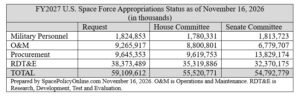
The Senate Appropriations Committee has released its fiscal year 2027 defense spending bill. It would give the U.S. Space Force $54.8 billion, about $4.3 billion less than the $59.1 billion the Trump Administration requested through the regular appropriations process. The bill also attaches conditions meant to curb sole-source contracting, singling out two large awards to SpaceX.
Space Force funding in context
The committee recommends $1.072 trillion for the Department of Defense, essentially matching both the Administration’s request and the level approved by the House Appropriations Committee. That figure is part of a $1.15 trillion defense request that also covers non-DOD agencies, such as the Energy Department, which oversees the nuclear stockpile.
President Trump has asked for $1.5 trillion in defense spending for FY2027. The remaining $350 billion would come through a separate reconciliation bill. For the Space Force, the request totals $71.1 billion: $59.1 billion in appropriations and $12 billion through reconciliation. The service received $32 billion in FY2026.
The committee’s report adds $2 billion for space-based airborne moving target indicator (AMTI) development and $3.3 billion for the Space Data Network. It also provides $520 million for the Next Generation Overhead Persistent Infrared Polar program and $88 million for commercial space-based ISR tied to responsive combatant command tasking. Another $7.1 billion would pay for 54 National Security Space Launches.
Sole-source concerns
The report also voices concern about the Space Force and the National Reconnaissance Office relying on non-competitive, sole-source contracts. It cites AMTI and the Space Data Network as examples of competition being set aside. SpaceX received both awards: $4.16 billion for AMTI and $2.29 billion for the Space Data Network.
Appropriators want the added money for those two programs used to bring in multiple vendors. Section 8127 of the bill would write that into law by limiting the use of funds for sole-source or non-competitive awards.
The bill further funds commercial space-based sensing, in-orbit refueling, propulsion test infrastructure for emerging commercial launch systems, and non-federal spaceports. It also funds an expansion of Protected Tactical SATCOM-Global to meet the program’s original objectives.
Reconciliation remains uncertain
The fate of the $350 billion sought through reconciliation, including the Space Force’s $12 billion, is unresolved. Reconciliation falls outside the appropriations committees’ jurisdiction and lets the Senate pass legislation with 51 votes rather than the 60 needed to overcome a filibuster. Two reconciliation bills have already been enacted in this Congress: last summer’s One, Big Beautiful Bill Act and this year’s Secure America Act. The push for a third, with another $350 billion for DOD, is meeting resistance from both parties. The House approved $60 billion within a broader $95 billion budget resolution in July, the first procedural step. Rumors suggest the Senate may move soon, but the amount for defense is unclear.
Subcommittee chair Sen. Mitch McConnell (R-Kentucky) argued that reconciliation money, which lasts one year, is no substitute for steady annual funding. Accordingly, the committee put $69 billion of the $350 billion into this bill, though none of it appears to go to the Space Force.
That affects Golden Dome. Nearly all of its request, $17.1 billion of $17.5 billion, was slated for reconciliation. The committee provides $9.4 billion of that $17.1 billion.
Calendar pressures
With this release, the committee has made public all 12 of its bills. Chair Sen. Susan Collins (R-Maine) has not said whether or when the panel will meet to debate them. The House committee cleared all of its bills over the summer, but none has passed the full House.
The government is operating under a continuing resolution that expires December 11. Many expect an extension into next year. Democrats are set to take control of the House and Senate on January 3, so Republicans could try to finish some bills before then, though time is short. A shutdown is not out of the question but currently appears unlikely.
Source: spacepolicyonline.com