Jupiter’s four largest moons are in the middle of a rare run of mutual eclipses and occultations, and observers in the Americas have a series of well-placed events to watch through the end of 2026. The Galilean satellites (Io, Europa, Ganymede and Callisto) will repeatedly pass in front of, or into the shadows of, one another during a viewing season that comes around only once every six years.
Why the moons line up
The cause is geometry. The Sun and Earth cross Jupiter’s equatorial plane about every six years, an alignment known as Jovian equinox, which falls on December 16 this year. The Galilean moons orbit within 0.04° to 0.25° of Jupiter’s equator, so around that time we see their orbits almost edge-on. From that vantage point the moons regularly cross each other’s paths. The season lasts several months on either side of equinox, and it is now roughly at its midpoint. The previous one took place in 2015.
These mutual events are separate from the familiar eclipses and occultations produced by Jupiter itself. Moon-on-moon eclipses are all partial or annular and can be hard to spot by eye, though deep ones, in which a moon dims by half a magnitude or more, are obvious. Occultations range from two moons barely overlapping to one passing directly in front of the other. Even when the pair can’t be split at mid-event, observers can watch them close in, blend into a single point or a tiny dumbbell, and then separate.
Events to watch through December
A timetable of 20 selected events from November 19 to December 31 has been compiled from data from the Space Service of the Paris Observatory and the British Astronomical Association’s Mutual Events of the Galilean Satellites 2026-2027, written by Thomas Morris. It favors events visible from the Americas, and start times are given in Eastern Standard Time (subtract one hour for CST, two for MST and three for PST). Each moon is numbered 1 to 4 from Io outward, so 3O1 means Ganymede occults Io and 2E4 means Europa eclipses Callisto. The table also gives the brightness drop, the duration, and the percentage of the target moon’s diameter covered.
Several events stand out:
- November 25: Callisto eclipses Europa, starting at 4:22 a.m. EST. Europa fades by 0.9 magnitude, which should be visible even in a small telescope, with 65% of its diameter covered over about 11 minutes.
- December 19: Europa passes in front of Ganymede starting at 10:46 p.m. EST, covering 90% of the larger moon’s diameter over about 35 minutes. This is the closest to a complete merger on the list.
- December 20–21: Io occults Callisto at 2:27 a.m. EST on the 20th, covering 53% over 27 minutes. At 4:00 a.m. on the 21st, Europa eclipses Ganymede for 48 minutes, covering 58%.
- December 31: Ganymede eclipses Io starting at 2:20 a.m. EST. Io dims by 0.6 magnitude, with 80% of its diameter covered over nearly 29 minutes.
The longest event on the list is the December 6 occultation of Ganymede by Europa, at nearly 57 minutes, though it covers only 44% of the target’s diameter.
Observing and imaging
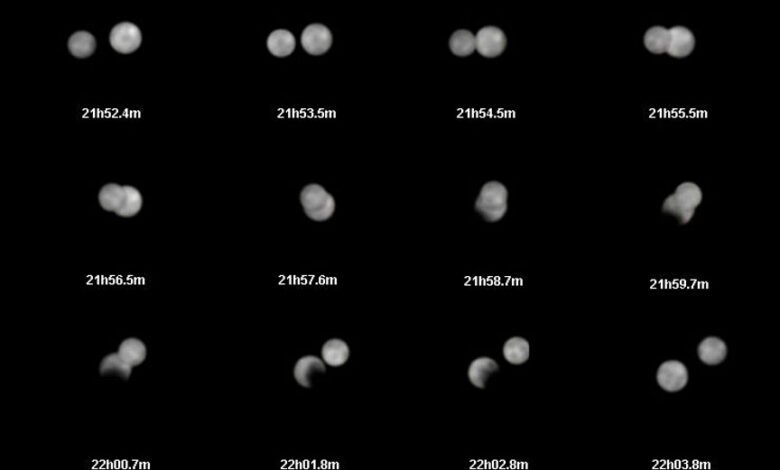
Magnifications of 200× or more help keep approaching and receding moons cleanly separated during occultations. During deeper eclipses, observers may even notice the bite taken out by a neighboring moon’s shadow. Planetary imagers using 8- to 16-inch telescopes and CMOS cameras can record video of the events and assemble time-lapse sequences, as John Sussenbach did with a Celestron C14 during the 2015 season. Near-misses, in which two moons pass close without an event, also occur frequently and can make appealing visual pairings.
Additional events into 2027 are listed in the data sources cited above.
Source: skyandtelescope.org