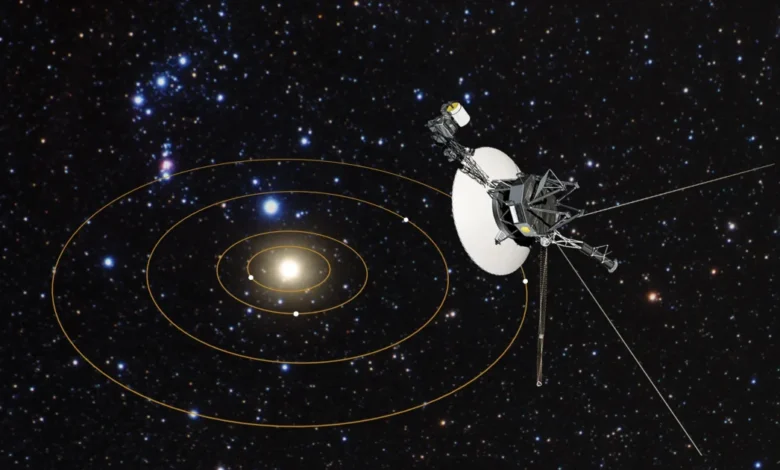
Voyager 1 will become the first spacecraft to reach a distance of 1 light-day from Earth at 5:16 a.m. EST on Wednesday, Nov. 18. At that range, a command sent from Earth needs 24 hours to arrive, and the spacecraft’s reply takes another 24 to return. NASA is marking the occasion by asking the public to send a signal skyward on the evening of Tuesday, Nov. 17.
A distance measured in light travel time
A light-day is the distance light covers in 24 hours. At about 186,000 miles per second (299,792 km per second), that comes to roughly 16.1 billion miles (25.9 billion km). By comparison, the Moon is about 1.3 light-seconds away and the Sun about 8.3 light-minutes. Neptune lies a little over 4 light-hours from Earth. Proxima Centauri, the nearest star beyond the Sun, is more than 1,500 light-days away.
Voyager 1 is moving at nearly 38,000 mph (61,000 km/h). Even at that speed, it has taken more than 49 years to cover the distance light crosses in a day.
Where the Voyagers are now
Voyager 2 is about 2 billion miles (3.2 billion km) closer to Earth than its twin, and a signal takes about 20 hours to reach it. It is not expected to hit the light-day mark until November 2035.
NASA launched the two Voyager spacecraft in 1977 to visit the giant planets. Voyager 1 flew past Jupiter and Saturn. Voyager 2 continued to Uranus and Neptune and remains the only spacecraft to have visited either planet. Voyager 1 launched on Sept. 5, 1977, two weeks after Voyager 2, but followed a shorter trajectory to Jupiter. After its Saturn encounter in 1980 it left the planetary region of the solar system. About a decade later it captured the image of Earth known as the Pale Blue Dot.
Voyager 1 entered interstellar space in August 2012, and Voyager 2 followed in 2018. They are the only probes to have studied that region, beyond the Sun’s magnetic field, directly.
Stretching a shrinking power supply
Each spacecraft is powered by a radioisotope thermoelectric generator, the same type of power source used by the Curiosity and Perseverance rovers on Mars. The generators convert heat from the natural decay of plutonium-238 into electricity. Their output falls by about 4 watts per year, so engineers have spent years switching off components and instruments to conserve power.
This year, a risky maneuver nicknamed the “Big Bang” shut down several devices in a single coordinated step, intended to extend operations for both spacecraft and their remaining instruments by several years. Voyager 1 now operates two of its original 10 instruments, and Voyager 2 operates three.
How to send a signal
NASA is inviting people to flash Voyager’s call sign, V-G-R, in Morse code on Tuesday evening. Participants can use NASA’s automated flasher on a smartphone or tablet, or do it by hand with a flashlight:
- V: dot-dot-dot-dash
- G: dash-dash-dot
- R: dot-dash-dot
Dots are quick blinks, and dashes are flashes of about one second. Pause between letters. The exact positions of both spacecraft can be viewed on NASA’s mission status page.
Source: www.astronomy.com