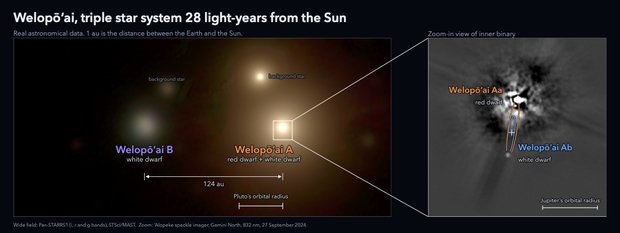
A red dwarf about 28 light-years from Earth has turned out to have two white dwarf companions, one of them sitting closer to it than Jupiter sits to the Sun. Astronomers say the arrangement is hard to explain. The system, named Welopōʻai, was identified by a team led by Étienne Artigau at the University of Montreal, working with the Trottier Institute for Research on Exoplanets (IREx). Their results appear in Astronomy & Astrophysics.
From an exoplanet search to a hidden white dwarf
The team used the SPIRou spectrograph on Mauna Kea to look for exoplanets around the red dwarf IRAS 21500+5903 in the constellation Cepheus. The star’s velocity changed far more than any planet could account for. That pointed to a massive companion, with a mass of up to half that of the Sun.
Follow-up observations with the Gemini North telescope, using its ʻAlopeke instrument, imaged the object and showed it to be a white dwarf.
The star was already known to be part of a binary, with a second white dwarf far from the primary. The name Welopōʻai comes from the ʻImiloa Astronomy Center of Hawaiʻi and combines the ideas of lineage and an orbital circle. The components are Welopōʻai Aa (the red dwarf), Welopōʻai Ab (the new white dwarf) and Welopōʻai B (the distant one). Ab lies about 4.6 AU from the red dwarf, slightly less than Jupiter’s distance from the Sun. B orbits roughly 124 AU out.
A survivor of the red giant phase
The inner white dwarf is assumed to have started out about 40 percent more massive than the Sun. A star of that mass would have swollen into a red giant, which should have engulfed a companion at such a short distance. The red dwarf nonetheless appears to be in a stable orbit with it. Patrick Dufour, a University of Montreal white dwarf specialist and co-author, said the researchers have no clean explanation for how the system reached this state, and that this question is shaping their next observations.
The paper proposes one possibility. If the outer white dwarf’s orbit is sufficiently tilted relative to the inner pair, it could drive Kozai-Lidov oscillations, in which an outer body’s gravity cyclically changes the shape and orientation of an inner orbit. That could strongly affect the eccentricity of the inner stars’ orbit. The oscillations are expected in this system, but observations have not yet shown how pronounced they are. More data are needed to test the idea and to show how such interactions unfolded over time.
The team has also released an animation and sonification of the system. It turns the stars’ orbital motions into musical tones, with pitch and timing shifting as the inner orbit becomes more elongated and then more circular. Heidi White of IREx produced it, using simulation data from Alexandre Correia of the University of Coimbra.
Next steps
The researchers plan to refine the system’s parameters with further Gaia data, archival-plate astrometry and observations from the James Webb Space Telescope. Webb photometry could also address an unexpected infrared excess at Welopōʻai Ab. This may indicate a debris disk, though the authors regard that as tentative.
The paper, “Welopōʻai: A peculiar triple system 8 pc from the Sun,” is published in Astronomy & Astrophysics, Vol. 715, A321 (November 2026).
Source: www.centauri-dreams.org