DARPA’s NOM4D program has demonstrated automated assembly of a structure in orbit for the first time. The result is an early step toward building antennas, solar arrays and other large systems in space that are too big to fit inside a rocket fairing. NOM4D stands for Novel Orbital and Moon Manufacturing, Materials and Mass-efficient Design.
A truss built in orbit
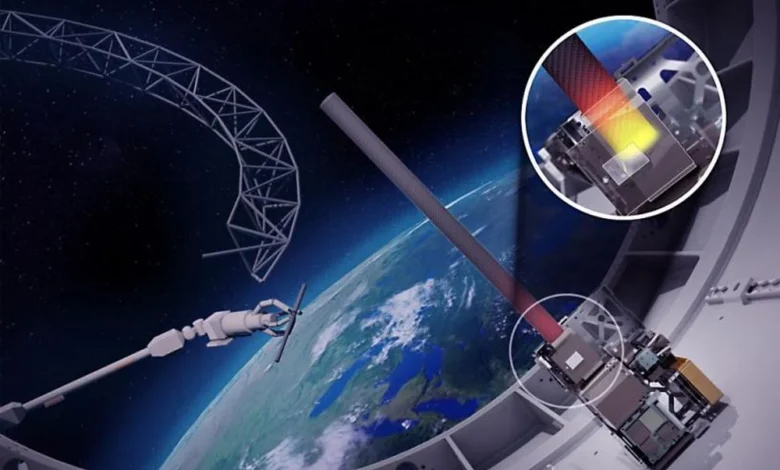
The demonstration used a gantry robot, a linear machine that moves along x, y and z axes, to build a truss. The payload was developed by Caltech and consisted of individual structural members with custom joints. While the truss was assembled, the system also applied a thin reflective mesh of the kind a space-based antenna might use.
According to NOM4D program manager Andrew Detor, the Caltech approach resembles Tinkertoys or K’nex. Truss members are joined at nodes one section at a time inside an automated assembly box. Each section is built piece by piece and fitted with mesh, then deployed once complete. Detor said the system relies on sound engineering rather than complex robotics or advanced algorithms, and that this is what lets the process scale. The program’s stated goal is structures hundreds of meters to kilometers across, a scale he said cannot be reached today.
Ahead of schedule
The program moved faster than planned. In February 2025, NOM4D replaced a third phase of more precise laboratory work with on-orbit testing. Caltech and the University of Illinois Urbana-Champaign, which had completed the first two phases, partnered with launch companies for the new phase. SpaceX launched the Caltech payload in March 2026.
Detor said it took 15 months to go from the idea of an orbital demonstration to a working prototype in space. He added that operating in orbit leaves almost no margin for error, which is why testing in the real environment matters for maturing the technology.
Next: composite processing on the ISS
The next test will come from the University of Illinois Urbana-Champaign team, which will send an experiment to the International Space Station. It goes beyond assembly to demonstrate composite material processing. A monomer resin will be heated by an energy-efficient method to form a strong polymer, producing a high-strength structure in space. The process is comparable to the resin use in carbon fiber reinforced polymer manufacturing, where strength and low weight are critical for aerospace components.
If that test succeeds, Detor said, the program can begin considering what to actually build with the technique.
Possible applications
The source outlines several uses, none of which is yet under construction:
- Orbital stations: Transfer stations in low Earth orbit and lunar orbit, similar to the proposed Lunar Gateway, could combine prefabricated modules with frameworks made by NOM4D-type systems.
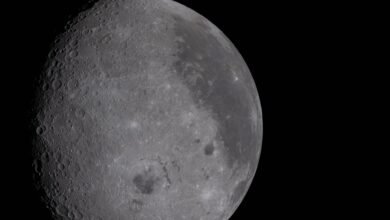
- Lunar habitats: Robotic assembly could reinforce the Moon’s apparent subsurface lava tubes, which offer natural protection from hazards, and convert them into habitats.
- Large telescopes: A liquid mirror telescope could be built in a lunar crater from components shipped separately. NASA’s Lunar Crater Radio Telescope concept would place an antenna in a far-side crater, shielded from Earth’s radio interference. Both ideas still await the necessary engineering.
Detor also pointed to large depots, habitats, solar arrays for power and radio antennas as the kinds of structures a future space economy will need. Gerard K. O’Neill’s rotating habitat concept, the O’Neill Cylinder, remains a distant prospect, though the ability to assemble large structures in orbit could eventually bear on such ideas.
Detor described the Caltech demonstration as a beginning rather than an endpoint. The open question for the program, he said, is what to build now that a process capable of scaling to large structures has been shown to work.
Source: www.universetoday.com