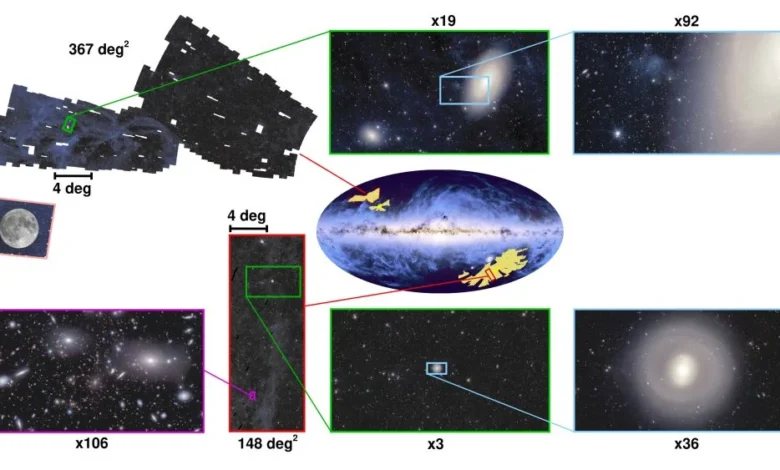
The European Space Agency’s Euclid space telescope has released its first major cosmology dataset, DR1-Foundation. It draws on roughly 13 months of observations and is the largest body of Euclid data made public so far. The release covers a patch of sky equivalent to about 9,500 full moons and records light from more than one billion objects.
The data come from Euclid’s Wide and Deep Surveys, which will form the backbone of the mission’s three-dimensional map of the Universe. The release spans 1,900 square degrees, about 14% of the area Euclid is expected to cover over its six-year mission. Earlier Euclid releases were far smaller. One of them was a roughly 60-square-degree view assembled from a few days of observing, which included targets such as the Horsehead Nebula and the Perseus galaxy cluster.
Why the mapping matters
Dark energy and dark matter act on the largest scales, so studying them means surveying as much of the Universe as possible. Euclid is designed to chart galaxy superclusters, the filaments they lie along, and the voids between them. Those patterns should sharpen understanding of both phenomena.
Other projects have mapped cosmic structure, some for decades. The ground-based Dark Energy Spectroscopic Instrument (DESI) has produced the largest 3D map to date, but Euclid’s is expected to surpass it in depth and volume. Because Euclid operates in space, it avoids atmospheric interference and should achieve higher resolution.
Two surveys, two roles
The Wide Survey is Euclid’s primary campaign and will cover almost half of the galactic sky. It combines visible and near-infrared imaging with spectroscopy. As the main cosmology survey, it samples a large volume to constrain dark energy and dark matter.
The Deep Survey targets regions within the Wide Survey and looks for fainter objects, including dwarf and low-mass galaxies, tidal tails, high-redshift galaxies and quasars. It also helps calibrate the Wide Survey, and its higher density of sources supports separate science of its own. A cosmological survey needs both the volume of the one and the depth of the other.
Images from the release
The release includes several showcase images. One shows the core of the Messier 81 galaxy group, centered on its largest member, Messier 81, with the smaller member NGC 3077 to the left. Faint “galactic cirrus” clouds and an irregular dwarf galaxy are also visible.
Another shows NGC 1291, also known as the Golden Eye galaxy, a ring galaxy about 33 million light-years away. It has an inner ring, an outer ring and an inner bar. The rings may stem from a past merger with a gas-rich galaxy.
A third image shows part of Abell 3128, a cluster about 800 million light-years away with hundreds of galaxies. It belongs to the Horologium supercluster, which contains more than 30 smaller clusters, and Abell 3128 is one of its richest members. A gravitational lens near its center warps and magnifies light from a more distant background galaxy. Part of another cluster, ACT-CL J0330-5227, appears in the same frame. The two are separated by around 5 billion light-years and overlap only along our line of sight.
Massive clusters like Abell 3128 are useful probes of dark matter. As gravitational lenses, they reveal where dark matter is concentrated, and they let cosmologists test the Lambda-Cold Dark Matter model, the standard cosmological framework. They also help Euclid calibrate itself.
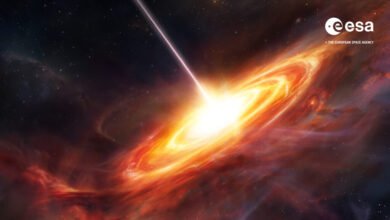
Euclid’s results so far include a new comet, a very ancient quasar and fresh images of the crowded center of the Milky Way. Earlier imagery from the 2024 Early Release Observations and the 2025 Quick Release 1 (Q1) can be explored on ESA Sky.
Source: www.universetoday.com