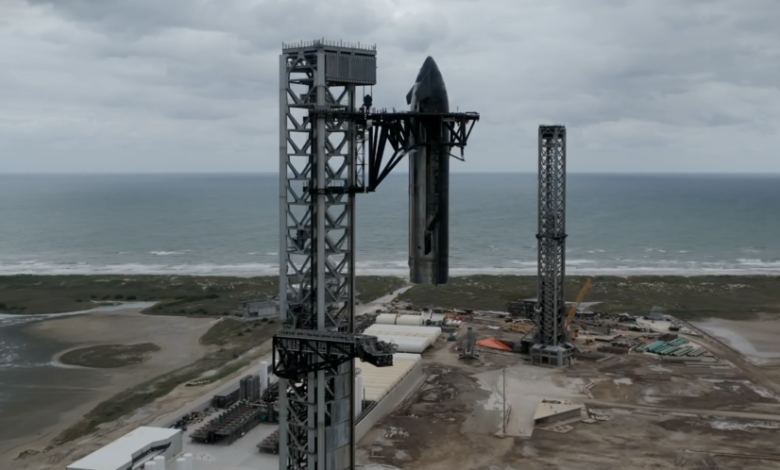
SpaceX has caught a Starship upper stage after a trip through orbit, a first for the program. Ship 42 was grabbed out of the air by the “chopstick” arms of the Mechazilla launch tower at Starbase, Texas, at 4:20 p.m. ET Saturday. The catch came at the end of Flight 15 and moves Starship closer to the full reusability SpaceX has pursued from the start.
A 14-orbit flight ends at the tower
Flight 15 lifted off from Starbase at 5:47 p.m. ET Friday. Ship 42 deployed its payload and completed 14 orbits. More than 22 hours after launch, it relit a single Raptor engine to leave orbit and headed back toward the Texas coast.
The vehicle made a final “swoosh” maneuver over the Gulf, then descended through the clouds. It lit three Raptors for the landing flip and a slow descent into the waiting tower arms. SpaceX Communications Manager Dan Huot closed the roughly 23-hour livestream by saying the company had caught a Starship and that the achievement changes the program’s prospects.
Why the catch matters for reuse
Because Ship 42 came back intact, it could in theory fly again. That is the prerequisite for the rapid turnaround SpaceX is aiming for. On the company’s third-quarter earnings call, CEO Elon Musk described the goal as landing the rocket and launching it again immediately, much like an airplane. He also said he expects weekly Starship flights at some point in the first half of 2027.
President and COO Gwynne Shotwell said on the same call that SpaceX aims to refly the second stage by early next year and to increase its launch cadence as it progresses toward rapid reusability.
Ship 42 carried a few Easter eggs. “Don’t Panic,” a nod to The Hitchhiker’s Guide to the Galaxy, was painted on the vehicle, and a heat-shield tile signed and installed by YouTuber MrBeast was on board.
Booster 22 lost over the Gulf
The mission did not deliver SpaceX’s first double catch. Super Heavy Booster 22 never reached the tower. According to SpaceX, only 32 of its 33 Raptor engines relit for the boostback burn, and the burn ended early because of low fuel mass.
The booster’s guidance system then triggered an automated abort and diverted it offshore. It hovered over the Gulf before its flight termination system was triggered. SpaceX is still investigating the root cause of the anomaly.
26 Starlink V3 satellites deployed
Ship released 26 Starlink V3 satellites during the flight, the same number as Flight 14 in September. SpaceX said it made contact with every satellite and that all have begun raising their orbits to join the Starlink constellation.
Source: payloadspace.com