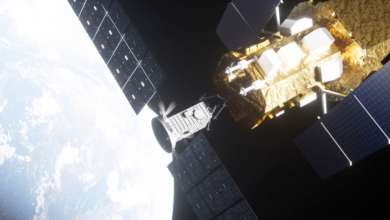
The European Space Agency’s Hera spacecraft has reached the Didymos-Dimorphos asteroid system, arriving on November 11 about four years after NASA’s Double Asteroid Redirection Test (DART) deliberately struck Dimorphos, the small moonlet of asteroid 65803 Didymos. Hera’s task is to examine the aftermath of that impact at close range.
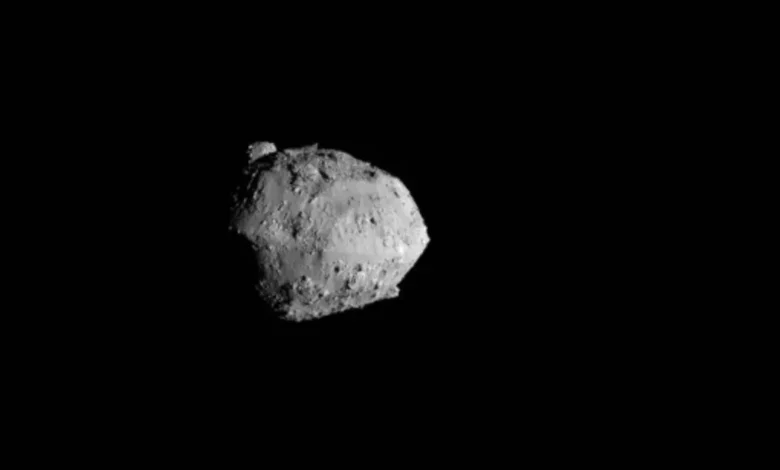
ESA’s first close-up image from the encounter was taken with Hera’s monochrome Asteroid Framing Camera from a distance of 600 kilometers. It shows Didymos clearly but gives only a brief glimpse of Dimorphos. A second image, released later, shows Dimorphos mostly hidden behind its larger companion. ESA is holding back the first full look at Dimorphos since the impact for a special event in Berlin, Germany, on November 25.
Flying alongside a low-gravity target
Didymos is only about 780 meters (2,600 feet) across, too small to hold Hera in a stable circular orbit at a safe distance. The spacecraft therefore travels alongside the asteroid pair, observing from 25 to 30 kilometers (16 to 19 miles) away. Its position drifts relative to the system’s center of mass at about 12 centimeters per second (0.3 mph), roughly twice the top speed of a Mars rover.
Every three or four days, Hera fires its thrusters briefly to turn its path by 90 degrees. The result is a series of rectangular orbits, each taking about two weeks to complete.
Lighting for a topographic survey
This flight path keeps the asteroids well lit, with their disks mostly but not fully illuminated. Hera holds a position slightly to one side of the Sun, which gives a good view of the topography along the terminators, the boundaries between day and night, on both bodies. Didymos rotates once every 136 minutes, while Dimorphos circles it once every 12 hours. The data will help scientists build topographic models that will serve as a basis for more detailed mapping.
For comparison, DART’s own images of Dimorphos, taken just before the 2022 impact, show what the moonlet looked like beforehand. Hera’s views will reveal how it appears now.
Next phases
Hera will stay in this Early Characterization Phase orbit for two rectangular cycles, until December 2. It will then move closer, to distances of 8 to 20 kilometers, for the Detailed Characterization Phase.
Source: skyandtelescope.org