Heart and exercise research aboard the space station helps keep crews healthy

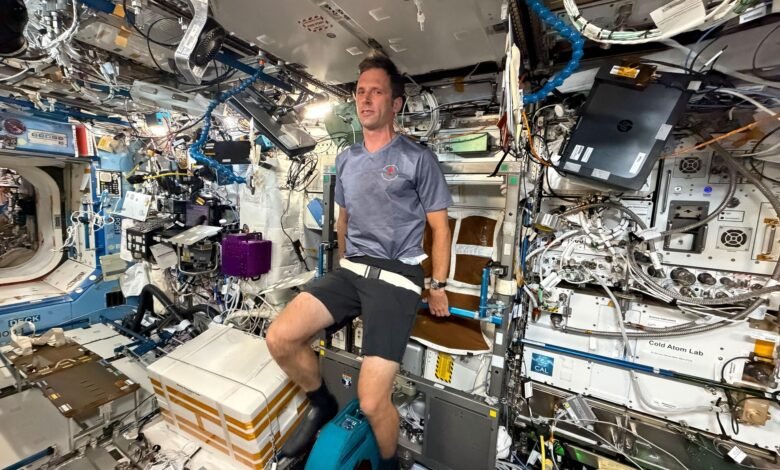
Expedition 75 crew members on the International Space Station spent Tuesday on cardiovascular research and exercise studies. They also continued loading scientific samples into a SpaceX Dragon cargo spacecraft that is preparing to return to Earth.
Blood flow study in the Columbus module
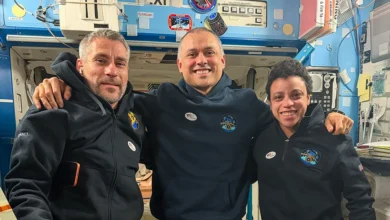
NASA flight engineer Luke Delaney served as a test subject in a study of how weightlessness affects an astronaut’s blood circulation. NASA flight engineer Anil Menon assisted him in the Columbus laboratory module, using the Ultrasound 3 device to scan Delaney’s veins and taking blood pressure measurements.
Delaney also wore a Thigh Cuff, a device that constricts blood flow and limits the fluid shift toward the head that occurs in space. His blood samples were collected for analysis of crew health.
Both astronauts also worked on other experiments. Menon activated mixing tubes holding botany samples, part of an activity meant to help students learn about space science. Delaney processed cells from the lining of the human respiratory tract. The work is intended to show how lung cells can be grown and maintained in microgravity.
Dragon cargo loading continues
After lunch, Delaney and Menon joined NASA flight engineer Jessica Watkins to move more science hardware from the station into the Dragon spacecraft. Samples returning on Dragon will be analyzed for the effects of microgravity on 3D bioprinted blood vessels and on antibiotic-resistant bacteria, among other subjects. The research is aimed at advancing health on Earth and in space.
Dragon has been docked at the station since Oct. 15 and is nearing the end of its stay. It will return soon for a splashdown in the Pacific Ocean.
Hatch inspections and exercise hardware testing
Flight engineer Joshua Kutryk began his shift by cleaning and inspecting hatch seals throughout the station’s U.S. segment. He checked that each hatch closes properly, holds an airtight seal and shows no wear.
He then did a series of resistive exercises on the European Enhanced Exploration Exercise Device, known as E4D. A computer tablet tracked his range of motion, repetition count and the equipment’s operation. The device is being evaluated for how well it can support muscle and bone health on crewed missions to the Moon, Mars and beyond.
Russian segment fitness study and maintenance
Roscosmos flight engineers Sergey Teteryatnikov and Anna Kikina took part in a study that measures a cosmonaut’s fitness level in microgravity. Teteryatnikov pedaled an exercise cycle in the Zvezda service module while sensors recorded his heart function, blood circulation and blood pressure. Kikina assisted him.
The two then transferred water from the Progress 96 cargo spacecraft into the station. Station commander Pyotr Dubrov replaced fuse boxes in the Zarya module and calibrated a gas analyzer that measures the composition of the station’s atmosphere.
Source: www.nasa.gov