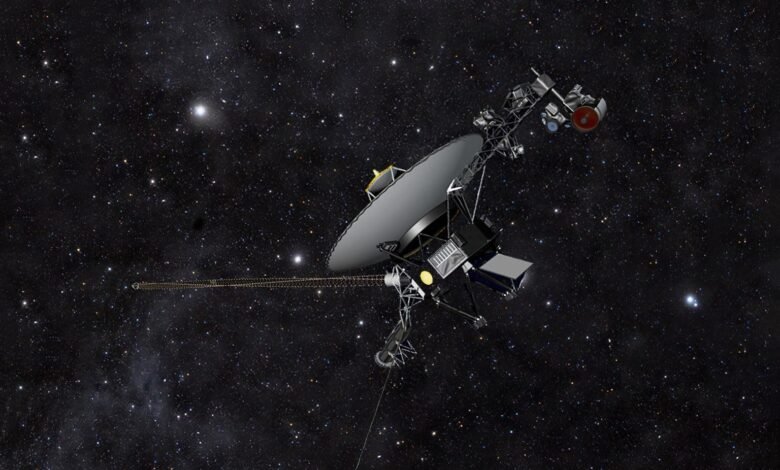
On November 18, 2026, NASA’s Voyager 1 will become the first spacecraft to be one light-day from Earth. That is the distance light covers in 24 hours: about 25.9 billion kilometers (16 billion miles, or 173 astronomical units). It makes the probe the most distant human-made object. Linda Spilker, Voyager Project Scientist at NASA’s Jet Propulsion Laboratory (JPL), discussed the milestone and the state of the mission in an interview with Florian Kappelsberger.
Putting a light-day in perspective
The Moon sits about 1.3 light-seconds from Earth and the Sun about 8.3 light-minutes away. Neptune, the outermost planet, lies roughly 4.2 light-hours out. Voyager 1 launched in September 1977, more than 49 years ago, and is now in interstellar space. According to Spilker, that region is not a true vacuum. It holds hydrogen and helium gas, traces of heavier elements produced largely in local supernovae, cosmic rays and small amounts of dust. Charged particles move along magnetic field lines there.
Two instruments left
Voyager 1 began its interplanetary mission with 10 instruments and a radio science investigation. Five were operating when the interstellar mission started in 1990. The spacecraft loses four watts of power per year, so systems have been shut down over time. Only the magnetometer and the plasma wave subsystem remain active.
Their data have already challenged expectations. Researchers had assumed that electron plasma density and magnetic field intensity would gradually decline as the probe moved away from the Sun. Instead, a strong event in 2020, possibly originating from the Sun, caused both to rise abruptly, and neither has fallen back since. Spilker said such results force scientists to revise their models.
Repairs across a two-day round trip
In 2024, Voyager 1 began returning unintelligible data. Engineers traced the fault to a damaged chip, possibly struck by a cosmic ray, and spent months writing code to work around it. With the probe nearly a light-day away, a command and its response took almost two days. Data resumed that April, confirming the fix.
The team now numbers roughly 10 people, some part-time. Its members range from a 25-year-old communications engineer to a 90-year-old expert on the flight data system computer. Spilker joined JPL in 1977 and coordinated science observations until 1990. She then moved to the Cassini mission, returned to Voyager in 2020 and took over scientific leadership two years later.
Voyager 2 and the mission’s end
Voyager 1 is heading north of the planetary plane after encounters with Jupiter, Saturn and its moon Titan. Voyager 2, which also visited Uranus and Neptune, is heading south and moving slightly slower. It will reach one light-day in 2035, by which time it will lack the power to transmit to Earth.
Spilker said no one can predict when Voyager 1 will fall silent. It could be today or several years from now. Clogging fuel lines and a gradually degrading plutonium-based power supply are among the signs of aging. If the signal is lost and cannot be recovered, the spacecraft will continue as a carrier of the Golden Record, the gold-plated copper phonograph disc with greetings in 55 languages, images of Earth and music. Its cover includes a map locating the solar system relative to nearby pulsars. In about 40,000 years, Voyager 1 will pass relatively close to another star.
Spilker plans to mark the milestone by stepping outside at a little after 2 a.m. local time in California and waving at the night sky.
Source: skyandtelescope.org