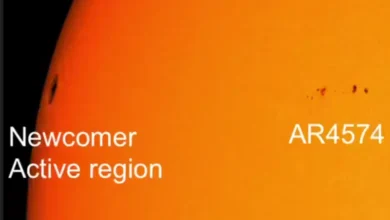
An H-alpha image of the Sun’s chromosphere, taken during a solar flare on May 14, 2025, shows energized hydrogen atoms streaming away from the solar surface. NASA featured the image as its Astronomy Picture of the Day. The flare was classified as M1 using observations from GOES (Geostationary Operational Environmental Satellites), which means it was moderately bright in X-rays.
Why the chromosphere is a puzzle
The chromosphere is the layer of the Sun’s atmosphere that sits just above the visible surface. Its temperature rises with distance from the Sun’s core, the reverse of what one would expect as heat moves away from its source. The source material says this is potentially explained by energy carried upward by swirling magnetic fields that extend through the solar atmosphere. The explanation is described as a possibility, not a settled conclusion.
The same magnetic fields can twist until they snap. That sudden release sends out light and energetic particles, an event known as a solar flare.
What the H-alpha filter reveals
The image was made with an H-alpha filter, which isolates light emitted by energized hydrogen atoms. This makes it well suited to showing material moving off the Sun’s surface during a flare, as in the May 14 event.
M-class flares and space weather
Solar flares are ranked by their X-ray brightness, and M-class events fall in the middle of the scale. They are not the most powerful flares the Sun produces. Even so, M-class flares can cause radio blackouts near Earth’s poles and minor radiation storms that can harm astronauts.
NASA, NOAA and other agencies monitor the Sun to identify and predict such storms. That monitoring is intended to protect people both on Earth and in space.
Source: science.nasa.gov