NASA’s Voyager 1 has reached a distance of one light-day from Earth, the point at which a radio signal needs a full 24 hours to travel between the spacecraft and the planet. The probe crossed the threshold at 5:16:07 a.m. ET, at a distance of 16.094 billion miles (25.902 billion kilometers).
In practical terms, a command sent to Voyager 1 now takes a day to arrive, and the reply takes another day to return, so a round-trip exchange lasts two days. Data from the spacecraft’s instruments is subject to the same one-day delay.
Nearly five decades in flight
Voyager 1 launched in 1977 and in August 2012 became the first human-made object to enter interstellar space. It returned images of Jupiter in 1979 and Saturn in 1980, then continued outward, reporting to NASA’s Jet Propulsion Laboratory in Pasadena, California.
Its twin, Voyager 2, visited Jupiter, Saturn, Uranus and Neptune. It has also entered interstellar space, though it left the heliosphere in a different direction.
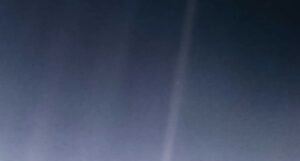
The spacecraft’s cameras were switched off in February 1990 to conserve power, shortly after Voyager 1 captured the “Pale Blue Dot” image of Earth on Feb. 14 of that year. In that picture, taken from 3.7 billion miles (6 billion kilometers), Earth appears as a tiny speck within a streak of scattered light. Voyager 1 is now 4.35 times farther away than it was then.
Three of its instruments still return data. Because the camera is off, there is no image of what lies around the probe. To mark the milestone, The Planetary Society commissioned space artist Don Davis to produce a digital painting, which it released during a virtual event on the evening of the milestone.
A finite power supply
Both Voyagers will mark their 50th anniversaries next year. Voyager 2 launched first, on Aug. 20, 1977, because it followed a longer, slower trajectory designed to reach all four giant planets. Voyager 1 launched on Sept. 5 on a faster path to Jupiter and Saturn.
Each spacecraft is powered by radioisotope generators that lose about 4 watts of electrical power per year. Communications are expected to end around 2029 for Voyager 1 and 2031 for Voyager 2 as that power declines. The spacecraft themselves will keep travelling through the galaxy after contact is lost.
Each carries a Golden Record containing sounds, music, spoken greetings and encoded images of Earth. The contents were selected by a committee chaired by astronomer Carl Sagan and Ann Druyan, who later became his wife. During The Planetary Society event, Voyager project manager Suzanne Dodd and project scientist Linda Spilker noted that the record will remain aboard after communications cease. They said it will orbit the center of the Milky Way for a billion years or more.
NASA’s Voyager website maintains a live chart of the positions of both spacecraft. The agency plans its own event to mark the milestone the following day at noon.
Source: spacepolicyonline.com