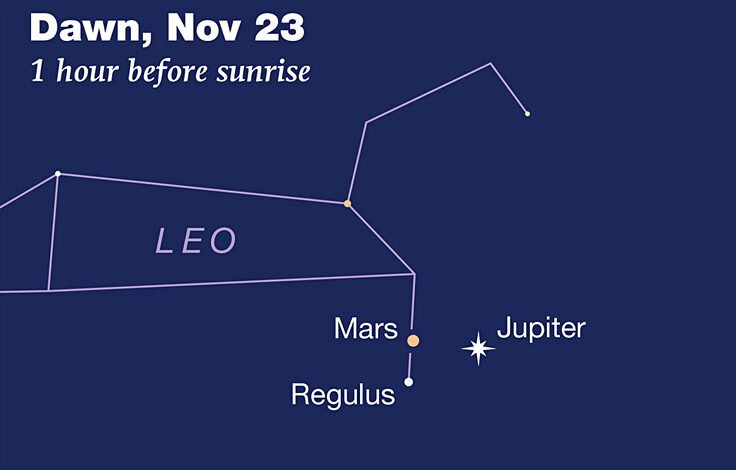
Early-morning planet groupings and a Full Moon highlight the observing calendar for the week of November 20–29, 2026. Mars, Jupiter and the star Regulus are drawing into a tight cluster in the pre-dawn sky, and the last-quarter Moon will join them on November 30. Venus and Mercury are separating in the east-southeast, and the evening sky offers Saturn, the Pleiades and a pair of Algol dimmings.
Mars, Jupiter and Regulus converge
By November 22, Jupiter (magnitude –2.1), Mars (+0.7) and Regulus (+1.4), the lead star of Leo, fit inside a circle 3.6° across. Mars is moving east against the background stars, so the shape of the triangle changes noticeably from one morning to the next. By November 25, Mars and Regulus form an isosceles triangle with Jupiter at the narrow apex.
The group rises in the east-northeast around 11 p.m. or midnight, depending on your position within your time zone, and stands high in the south by the start of dawn. On the morning of November 30, the last-quarter Moon moves in beside them, and the whole gathering fits within a 6° circle as seen from the Americas, roughly a typical binocular field.
Through a telescope, Mars is still small, about 7½ arcseconds across and gibbous. Jupiter spans 39 arcseconds. Both are growing, with Jupiter reaching opposition on the night of February 10 and Mars on February 19.
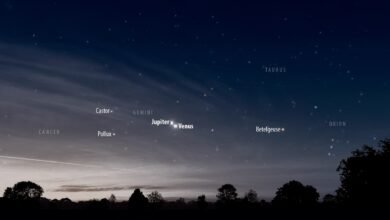
Venus and Mercury at dawn
Venus, at magnitude –4.8 and nearing a peak of –4.9 by the end of November, rises about an hour and a half before the first light of dawn. Mercury (–0.6) sits to its lower left and is sinking day by day, though for mid-northern observers it has reached its highest point of this apparition. The pair are 16° apart on November 21 and 22° apart by November 28. Spica stays 2° to 4° from Venus throughout. In a telescope, Venus is a shrinking, thickening crescent and Mercury a gibbous disk about 6 arcseconds tall.
Evening sky highlights
The Moon passes close to Saturn on the evening of November 20. Saturn, at magnitude +0.7 in Cetus, is the first point of light to appear in the southeast at dusk and crosses the meridian around 8 or 9 p.m. Neptune (magnitude 7.8) lies 6° west of it, and Uranus (5.6) sits in Taurus between the Pleiades and Aldebaran.
The Moon is exactly full at 9:54 a.m. EST on Tuesday, November 24. On the evening of November 23 it sits about 4° west of the Pleiades, and on the 24th about 11° to their east.
Algol reaches minimum brightness, magnitude 3.4 instead of its usual 2.1, for a couple of hours centered on 9:17 p.m. EST on November 26 and 9:06 p.m. EST on November 29.
On November 29, the Andromeda Galaxy (M31) and the Perseus Double Cluster, both cataloged at magnitude 4 and 22° apart, are visible to the unaided eye from reasonably dark sites. Binoculars make them easier to find.
Why sunsets are already so early
On Thanksgiving, November 26, the Sun sets within about two minutes of its earliest time for observers near 40° N. That minimum falls around December 7, nearly three weeks before the winter solstice, so sunset is slightly earlier on Thanksgiving than on Christmas. The offset is balanced at the other end of the day: the latest sunrise does not arrive until January 4. Both effects come from the tilt of Earth’s axis and the eccentricity of its orbit.
The directions and times above are written for mid-northern latitudes, and Moon positions are given for North America.
Source: skyandtelescope.org