NASA has selected 302 small business projects under its Small Business Innovation Research and Small Business Technology Transfer (SBIR/STTR) program, committing up to $171 million in seed funding for technologies aimed at lunar and Mars exploration. The work addresses needs tied to the Artemis program and the planned establishment of a U.S. Moon Base, and it is intended to support the domestic space economy.
The projects cover early-stage research and development in areas such as next-generation batteries, robotic systems able to sense conditions in the harsh lunar environment, and tools for preparing critical infrastructure, including lunar landing pads.
Two funding phases
The program supports entrepreneurs, startups and small businesses in advancing technologies that could serve NASA missions and reach commercial markets. Companies move through the program in phases, and this round included two of them.
Phase I contracts provide up to $225,000 each to establish the merit and feasibility of a proposed innovation. Some of these are STTR awards, which go to small businesses partnered with research institutions. The 98 Phase II contracts are worth up to $1.3 million each and continue work begun under Phase I projects selected in 2025, with a focus on demonstrating and delivering the technologies.
Selected projects
Opterus Research and Development Inc. received a Phase II award to develop a modular system of rollable solar arrays for the surfaces of the Moon and Mars. The arrays can be handled robotically, work with various support structures and operate in dusty conditions. The technology could be scaled up to 50 kilowatts, offering a power source for both NASA and commercial companies building infrastructure on the Moon.
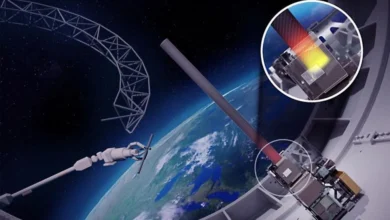
Intelligent Fiber Optic Systems Corporation leads a Phase I project on a 10-foot extendable robotic arm that combines a camera with sensors that measure surface texture, contact force and temperature. The goal is to let lunar rovers carry out complex tasks independently, such as cleaning solar panels, positioning habitat structures and collecting samples in hard-to-reach places. NASA notes that similar arms could inspect and repair power lines, nuclear reactors and other infrastructure in hazardous settings on Earth.
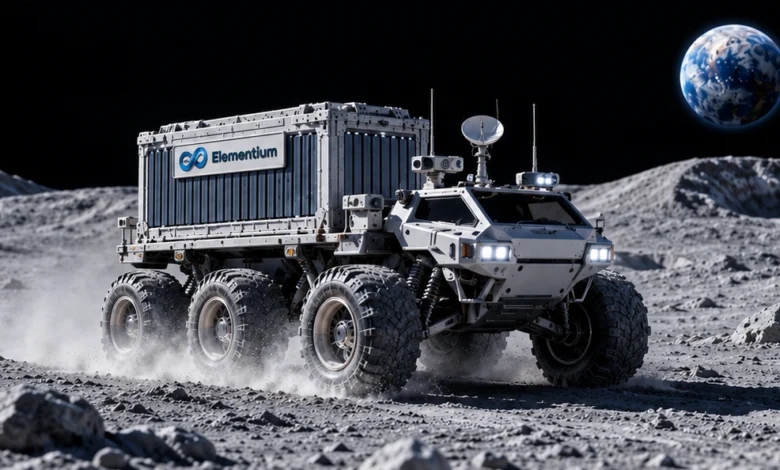
Elementium Materials Inc., also with a Phase I award, is working on a battery module that can operate down to minus 76 degrees Fahrenheit without active heating. That could reduce the heaters and insulation needed on the Moon, freeing mass and space for other tools and science experiments. The module could help keep rovers, habitats and other infrastructure running through the 14-day lunar night, and potentially on Mars.
Slate Geotechnical Consultants Inc. and the Colorado School of Mines, supported by an STTR Phase I award, will evaluate two approaches to preparing lunar regolith for repeated landings. Without prepared surfaces, rocket exhaust can blast loose, gravel-like regolith away, throw up dust or create craters, potentially damaging spacecraft and nearby infrastructure. The team will also study how rovers could repair and maintain future landing pads.
The SBIR/STTR program is part of NASA’s Research and Technology Mission Directorate and is managed by the agency’s Ames Research Center in California’s Silicon Valley. Complete lists of the selected Phase I and Phase II proposals are available on the program’s website.
Source: www.nasa.gov