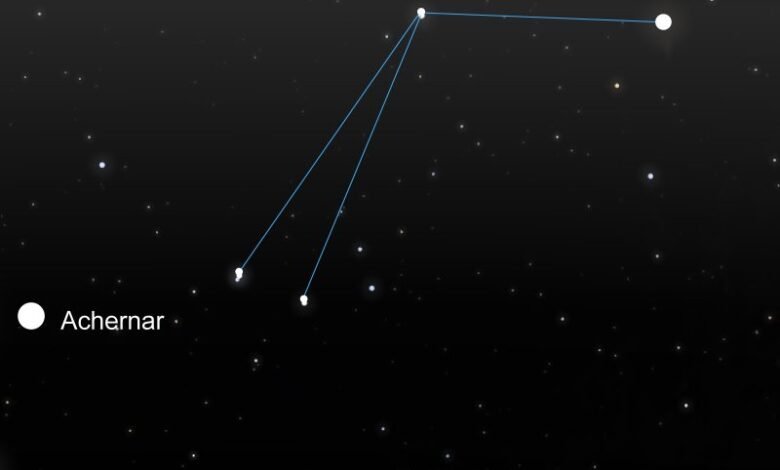
Tucana the Toucan is a faint constellation that never rises for most Northern Hemisphere observers, yet it is well known among stargazers. Its reputation rests on two objects at its southern edge: the Small Magellanic Cloud, a satellite galaxy of the Milky Way, and the globular cluster 47 Tucanae. Both can be seen without optical aid from dark southern skies.
Tucana lies close to the south celestial pole, the point around which all southern stars appear to revolve. From the Southern Hemisphere it is visible all year. Northern observers would need to travel south to see it. The constellation’s own stars are not bright, and they are harder to pick out than the galaxy and cluster that anchor its southern boundary.
The brightest stars in Tucana
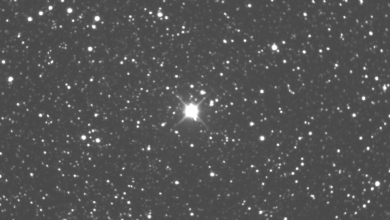
The brightest star in the constellation is Alpha Tucanae, at magnitude 2.87 and almost 200 light-years from Earth. On the opposite side of the constellation lies Beta Tucanae, a system of six loosely bound stars. Its three brightest members, Beta 1, Beta 2 and Beta 3, shine at magnitudes 4.36, 4.53 and 5.07. The whole system averages about 140 light-years away.
Small Magellanic Cloud
At 197,000 light-years, the Small Magellanic Cloud is still among the closest galaxies to Earth. From a dark site it looks like a misty patch. It is an irregular galaxy, but it has a central bar, which gives it the look of a disturbed former spiral. It is the smaller of the two Magellanic Clouds visible from the south. The larger, the Large Magellanic Cloud, lies in the constellations Mensa and Dorado.
The Small Magellanic Cloud holds many clusters and nebulae, and clusters stream along its length and from one tail, which makes it a rewarding telescope target. Dust within the galaxy obscures the view in visible light, but infrared observations from the Visible and Infrared Survey Telescope for Astronomy (VISTA) show it more clearly. Both Magellanic Clouds are being drawn toward the Milky Way and will eventually be absorbed by it.
47 Tucanae and NGC 362
The globular cluster 47 Tucanae, also catalogued as NGC 104, shines at magnitude 4.0. In excellent seeing conditions it appears as large as the full moon. It is the second brightest globular cluster in the Milky Way and contains millions of stars. Binoculars or a small telescope can resolve thousands of them.
Although 47 Tucanae appears near the Small Magellanic Cloud, the two are not related in space. The cluster is 14,500 light-years away, and the galaxy is about 14 times more distant. Their proximity in the sky is a line-of-sight coincidence.
On the opposite edge of the galaxy’s curving shape sits NGC 362, another globular cluster. At magnitude 6.4 it is dimmer than 47 Tucanae but still within reach of binoculars or small telescopes. It orbits the Milky Way on a highly eccentric path.
Hubble Deep Field South
Tucana is also the setting for one of the Hubble Space Telescope’s best-known observations. Beginning in the 1990s, Hubble made a series of “deep field” images by staring for long periods at a seemingly empty patch of sky, which let faint background objects emerge. The Hubble Deep Field South was taken in a small region of Tucana and shows a large array of distant galaxies from the early universe.
Source: earthsky.org