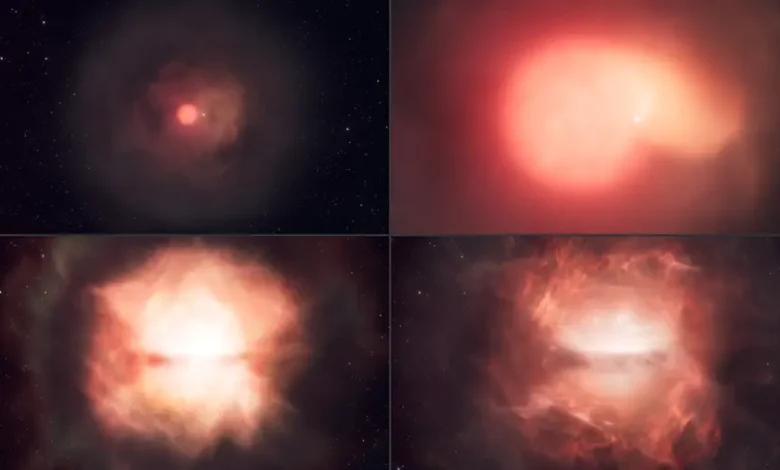
Astronomers have observed an entire stellar merger for the first time, from the early inspiral to the final eruption. The event, designated AT 2025abao, took place in the Andromeda Galaxy, where a small companion star spent about seven years spiraling into a red giant. Viraj Karambelkar of Columbia University and colleagues report the findings in the November 19 issue of Nature.
Earlier observations of stellar mergers, including luminous red novae such as V838 Monocerotis, have mostly captured the outburst at the end. Team member Morgan MacLeod of the Center for Astrophysics, Harvard & Smithsonian says this is the first time researchers have followed the infall in detail.
A slow brightening, then a sudden eruption
Karambelkar’s team first noticed the red giant brightening in data from NASA’s NEOWISE infrared survey. Archival records showed the rise began in 2018, while observations going back to 1989 found no variability in the star before that. The researchers interpreted the change as the opening phase of the giant swallowing a companion.
The primary star has about seven times the Sun’s mass and spans hundreds of solar diameters. As its core fuses helium, its outer envelope swells. The team estimates the companion at less than three-quarters of a solar mass. Once the giant’s extended atmosphere reached the smaller star, friction sapped the companion’s orbital energy and tightened its path. Gas passed between the two stars, and the system slowly grew brighter. When NASA’s SPHEREx mission imaged it in mid-July 2025, the primary had more than doubled in size.
The system erupted in October 2025, as the companion plunged into the giant’s core. The Zwicky Transient Facility spotted the outburst. NASA’s Neil Gehrels Swift Observatory and the Gemini North telescope on Mauna Kea, Hawai’i, followed up in November. The released energy blew off the giant’s outer layers, and in December 2025 the James Webb Space Telescope observed dust forming in the cooling, expanding gas.
Seven years may seem long, but it amounts to fewer than 10 orbits of the companion around the larger star. Mergers involving lower-mass stars can unfold in just days.
Why the view was so clear
MacLeod explains that mergers involving main-sequence stars, which are still fusing hydrogen in their cores, are compact and fast. In those cases light takes days to weeks to diffuse out of the ejected gas, which is as long as or longer than the infall itself, so the stages blur together. A giant star’s envelope is far more extended and less dense. The merger proceeds more slowly, but light escapes more quickly, giving a nearly real-time view of events.
Jason Nordhaus of the Rochester Institute of Technology wrote an accompanying perspective in the same issue of Nature. He says the observations match theoretical expectations for these mergers, known technically as common envelope evolution. They also support models in which convection, the boiling motion of gas inside stars, carries energy toward the giant’s surface.
Nordhaus also looks ahead. Upcoming wide-field surveys will image the sky repeatedly and generate large volumes of time-series data. He expects facilities such as the Vera Rubin Observatory in Chile and the Nancy Grace Roman Space Telescope to routinely find common envelope events in hundreds of nearby galaxies.
Source: skyandtelescope.org