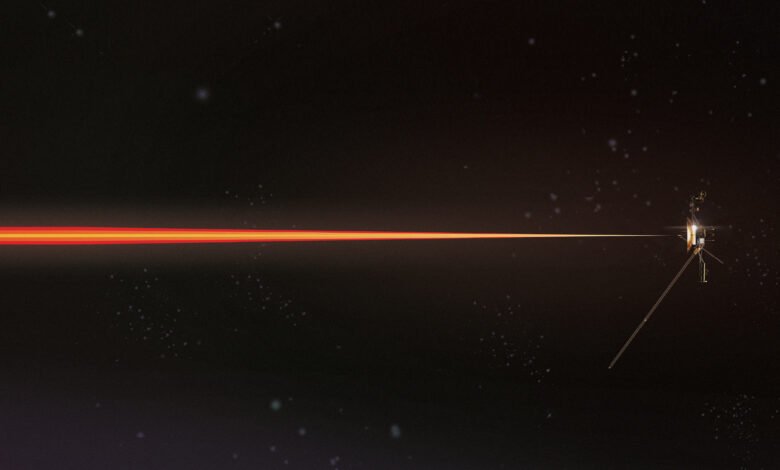
NASA’s Voyager 1 has reached a distance of one light-day from Earth, a first for any human-made object. The spacecraft crossed the threshold at 2:16 a.m. PST (5:16 a.m. EST) on Nov. 18, more than 49 years after it left Earth.
A light-day is the distance light covers in 24 hours, about 16.1 billion miles (25.9 billion kilometers). Because radio signals travel at light speed, a transmission from Voyager 1 now takes a full day to arrive. Team members at NASA’s Jet Propulsion Laboratory in Southern California, which is managed by Caltech, heard from the probe 24 hours after the crossing, early Thursday.
Confirmed without science data
The milestone comes with a caveat. The mission has not received science and engineering data from Voyager 1 since Nov. 14. The spacecraft is still transmitting a carrier signal, the radio signal that normally carries that data to Earth. Engineers combined measurements of the carrier signal with trajectory calculations to confirm the distance. They are still analyzing the problem affecting the data stream, and the source does not identify a cause.
Putting a light-day in perspective
Light travels about 186,000 miles (299,000 kilometers) per second in a vacuum. Sunlight takes roughly 1.3 seconds to cross from Earth to the Moon and about four hours to reach Neptune. It needs another 20 hours or so to reach Voyager 1. A light-year, by comparison, is 5.88 trillion miles (9.46 trillion kilometers).
A mission that outgrew its original goals
Voyager 1 and its twin, Voyager 2, launched in 1977 to take advantage of a rare planetary alignment. Managed by JPL, they were the third and fourth spacecraft to visit Jupiter and Saturn, and the first to return high-resolution images of those planets and their moons. Voyager 2 went on to study the ice giants Uranus and Neptune. The two probes remain the only spacecraft operating in interstellar space, and both continue to measure changes in the Sun’s magnetic field across vast distances.
Joe Westlake, director of NASA’s Heliophysics Division, said the Grand Tour of the outer planets alone would have made the mission remarkable. He added that Voyager later became central to NASA’s heliophysics fleet, which studies the Sun.
JPL Director Dave Gallagher described the milestone as a testament to the teams that built, programmed and now fly the spacecraft, and who have kept them in contact with Earth through numerous challenges. Caltech President Ray Jayawardhana credited the vision of Ed Stone, the Caltech physicist and JPL director who guided the mission for decades, along with generations of scientists and engineers who followed.
Each Voyager also carries a Golden Record, a gold-plated copper phonograph disc of images and sounds from Earth, intended as a message for any advanced civilization that might one day find it.
Source: www.jpl.nasa.gov