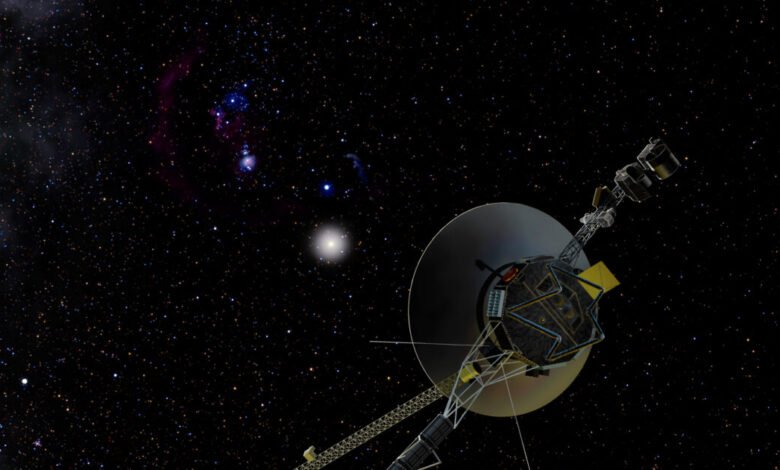
When Voyager 1 crosses the one light-day mark from Earth on Nov. 18 at 2:16 a.m. PT, a radio signal will need a full day to reach the spacecraft and another day for a reply to come back. Linda Spilker, a longtime member of the Voyager team, says that delay has changed how the mission operates. In a conversation with Sarah Al-Ahmed, she described the demands of commanding the probes at this distance and the plans for the mission’s 50th anniversary.
Commanding across a two-day round trip
Spilker said flight team members now need patience and careful planning. A command takes a day to arrive, and another day passes before the team learns whether it executed as expected.
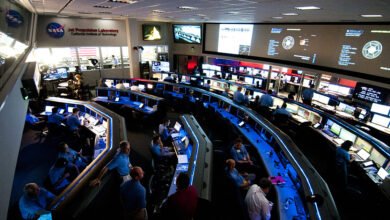
The ground infrastructure is also narrowing. Only one Deep Space Network station can send commands to both spacecraft: the 70-meter dish in Canberra, Australia. Its transmitter is powerful enough to reach the two Voyagers at their current distances, and no other station can do it. Voyager 2 dropped below the ecliptic after its flyby over Triton’s north pole, so only the Australian stations can still see it. More stations can view Voyager 1, but commanding still depends on the Canberra dish. Spilker said she hopes nothing happens to that station before the 50th anniversary.
How the Deep Space Network grew with Voyager
Spilker described the network as inseparable from the mission’s success. During the Jupiter and Saturn encounters, the Deep Space Network used 64-meter antennas. To return data at higher rates, extra panels were added at all three complexes, Goldstone, Madrid and Canberra, converting them to 70-meter stations. The spacecraft’s small tape recorder could hold only about 100 pictures, so engineers wanted to send images back as close to real time as possible.
She also cited a more recent example. Voyager 1’s tape recorder still works and is used to store some high-rate plasma wave data, which is played back about every six months. At the recorder’s slowest rate, the faint signal could be detected only by arraying Madrid’s 70-meter antenna with five 34-meter antennas, which was everything the Madrid complex had.
Plans for the 50th anniversary
Spilker said planning is under way for a large celebration, in collaboration with The Planetary Society and other groups. She is organizing a science symposium, likely lasting a couple of days at Caltech, covering the planetary phase, the interstellar mission and engineering milestones.
The team is also assembling a hard-copy book of 16 chapters on Voyager’s history. It is to cover the launch, planetary highlights, the interstellar phase and engineering topics, with a final chapter on how to build two spacecraft that can operate for 50 years. Spilker said the book is still in development.
The conversation opened with Al-Ahmed showing Spilker a piece of space art that evokes the Pale Blue Dot image. Spilker said it brought back memories and a sense of pride. Al-Ahmed noted that Voyager’s first close-up views of the outer planets have inspired space artists ever since.
Al-Ahmed also recalled that Spilker had earlier hoped people would go outside at the moment of the one light-day milestone and wave at Voyager. Spilker said she plans to do so herself, calling it a once-in-a-lifetime milestone.
Source: www.planetary.org