


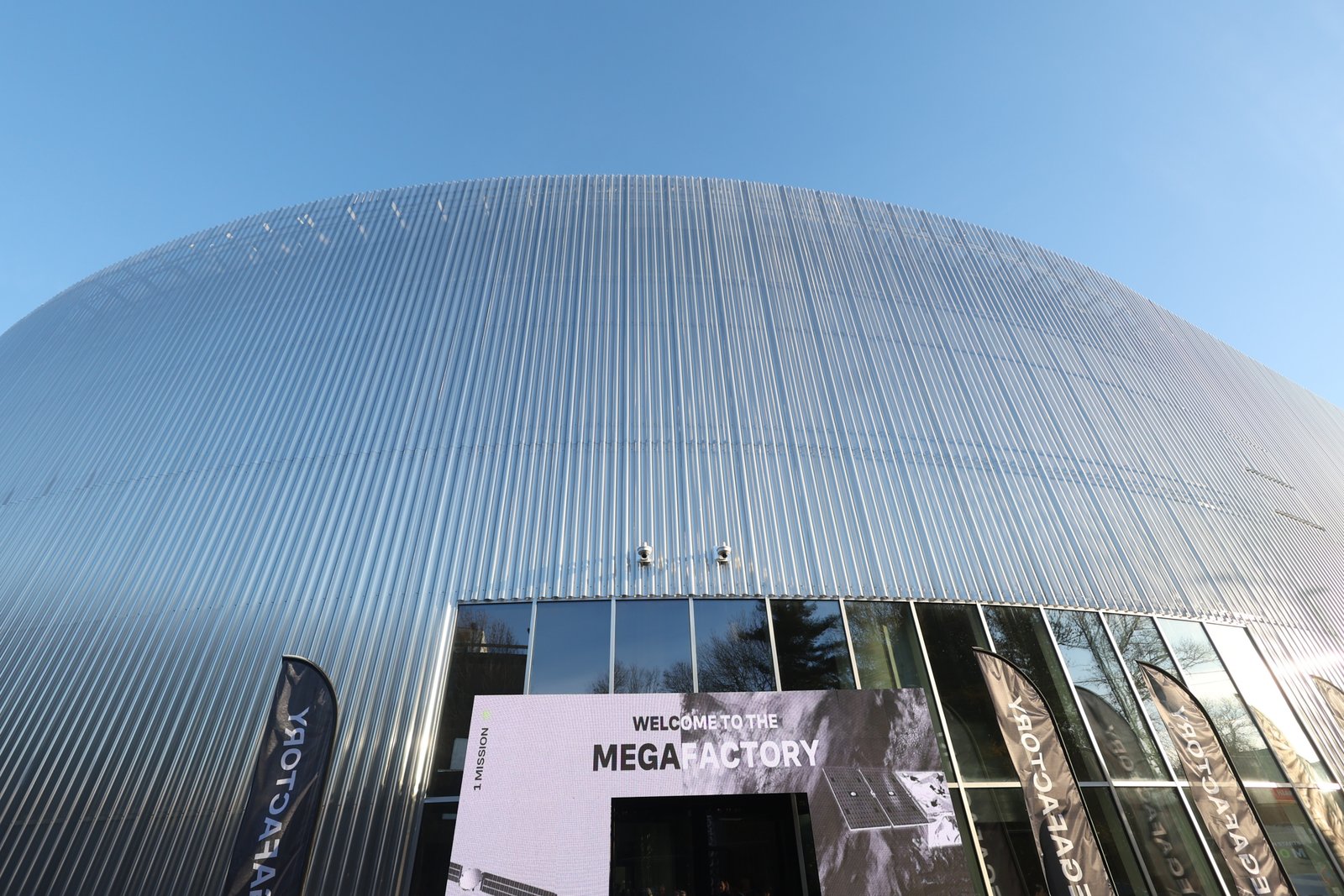
Belgian satellite maker Aerospacelab opened its new Megafactory in Charleroi, Belgium, on Tuesday. The company describes the 215,000-square-foot facility as Europe’s largest satellite manufacturing site. It is designed to produce up to 500 satellites a year and is expected to reach full production cadence next year. Aerospacelab is rebranding as Ectro on Nov. 30.
The opening comes as European governments and commercial operators prepare a new wave of constellations. It also follows a rare shift in how the region buys spacecraft. Large institutional contracts from European space agencies and defense ministries have traditionally gone almost exclusively to the established primes: Airbus, Thales, OHB and Leonardo. Aerospacelab has broken that pattern.
A startup wins the bulk of IRIS²
In September, the company was awarded a €2.4 billion contract to design, manufacture and deliver 264 low Earth orbit satellites for the European Commission’s IRIS² secure communications constellation. That is more than three-quarters of the planned 348-satellite fleet, and it was the first time a European startup had landed a contract of this kind.
The harder test lies ahead. Aerospacelab must now show it can deliver on schedule and within budget, something the established aerospace and defense primes have struggled to do on past programs.
From single satellites to assembly lines
In an interview with Payload, CEO Benoît Deper said the factory was a large bet that many in the industry considered too big for the European market. He said it is now overflowing with orders.
The change, he explained, is not only about satellites. The company is moving from building individual spacecraft to running assembly lines for hundreds of them, along with thousands of components. Deper said the component level is where supply chains are made or broken, and that Aerospacelab’s internal supply chains are now scaling accordingly.
He framed the IRIS² award as significant beyond the company itself. In his view, it was far from certain that Europe’s institutions and member states would trust new entrants, and the result suggests that pace, quality, price and performance still count in public procurement.
Deper also pointed to the company’s approach with legacy customers. European NewSpace firms have been growing for more than a decade, he said, but many remain sub-scale and are seen as innovation-department projects. Aerospacelab tried to adopt the language and thinking of traditional buyers while keeping the agility of a newer company, positioning itself as a link between the two.
Keeping the culture while becoming a prime
Deper said his main task is now preserving the company’s culture of transparency and proactive customer engagement. He acknowledged he does not yet know whether the company’s mitigation plan will work. He said this includes pushing back on specifications the company believes do not serve the customer’s needs, while explaining its reasoning rather than simply pricing compliance at a premium, as he said some legacy primes do.
Demand outlook
Deper described a market in which launch numbers are climbing while the customer base shrinks through consolidation. Vertically integrated entities spanning services, manufacturing and launch are emerging, he said, and many of them still buy components from Aerospacelab, which keeps its backlog growing. What the industry looks like in five to 10 years remains an open question.
He expects strong component demand and growing interest from operators seeking near-vertical integration through constellation supply. He also anticipates recurring IRIS² replenishment business, plus other countries, inside and outside the EU, funding their own layers on top of IRIS². Over the next five years, he said, the company expects to be busy.
Source: payloadspace.com