


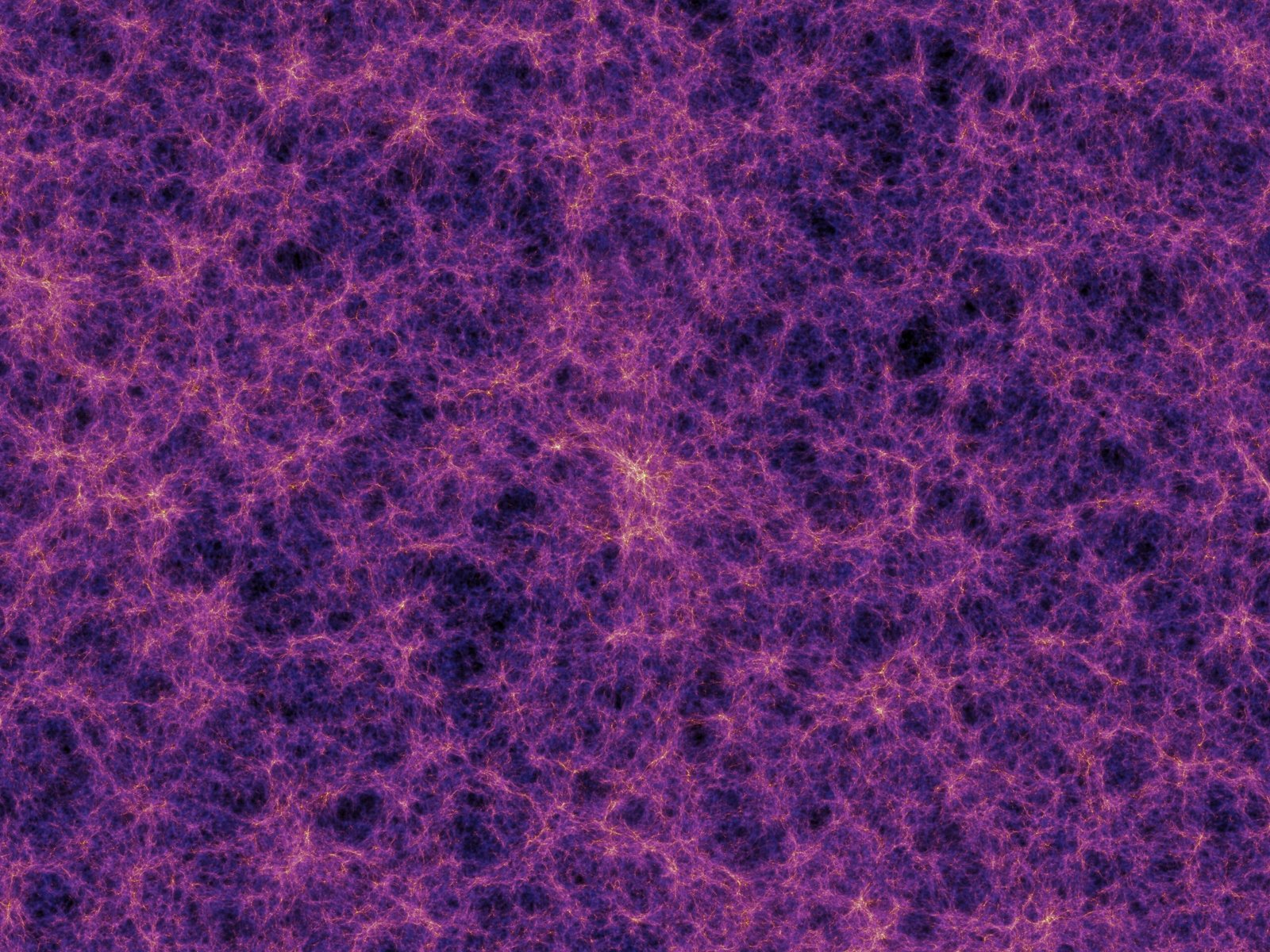
A refined method for locating the centers of cosmic web filaments suggests that the dark matter density profiles of these structures follow a universal pattern. The result, from a team led by Peng Xu of Peking University, comes from analysis of the TNG50 cosmological simulation and is published in The Astrophysical Journal Letters.
Why filament centers are hard to pin down
Most of the universe’s stars, galaxies and galaxy clusters lie along a network of intersecting filaments known as the cosmic web. The structure arose in the early universe, when overdense clumps of dark matter repeatedly pulled in material from nearby underdense regions. Matter built up along thin corridors that outline large voids, and where those corridors meet, still more material gathered, often seeding massive galaxy clusters.
Although this overall picture is well established, accounts differ on how dark matter is distributed inside the filaments themselves. Part of the problem is defining a filament’s center. DisPerSE, a software package widely used to identify structure in cosmological simulations, locates filament centers from a smoothed dark matter density map. That smoothing can place a center slightly away from the true peak in dark matter density, which distorts the density profile near the filament core.
The “shrinking cylinder” correction
Xu and colleagues kept the standard DisPerSE center estimates as a starting point, then added a “shrinking cylinder” algorithm that works from the raw, unsmoothed matter distribution. A large cylinder is first aligned with a filament segment, and the center of mass of the dark matter inside it is calculated. Progressively smaller cylinders are then drawn around each newly found center of mass, until the filament’s spine settles at a stable position.
Applied to TNG50, the correction changed the picture. The researchers found that dark matter density rises sharply toward the centers of filaments, a feature that conventional DisPerSE-based analyses tend to wash out. The rise is mainly attributable to dark matter halos clustered near filament cores. With those halos removed, the density of the remaining dark matter does flatten toward the center, but the team says this flattening is no longer an artifact of poor centering.
Signs of a universal profile
The team also found indications of a universal pattern. When the density profiles were scaled by the virial radius of the intersection nodes at the ends of each filament, they were highly consistent across different cosmic epochs, with a near-universal relationship at all redshifts examined.
This echoes scaling relationships already known for dark matter halos, and it suggests that filaments, like halos, grow through a self-similar process. The result comes from a single simulation, and the study stresses that much work remains before these structures are well understood. It does show that a modest change to an existing pipeline can alter conclusions about filament structure.
The study is titled “Universal Dark-matter Density Profiles of Cosmic Filaments” (ApJL 1009, L26).
Source: aasnova.org