


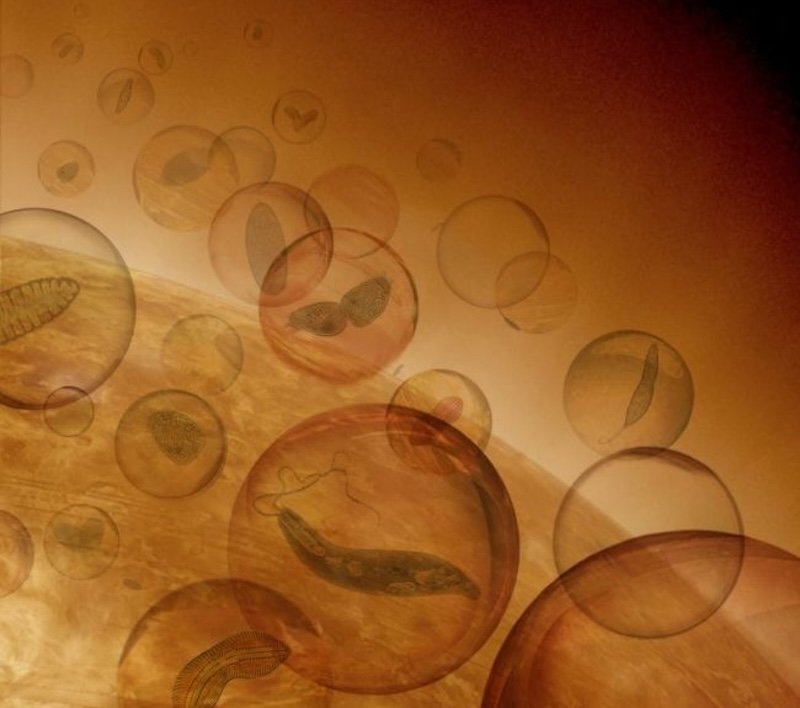
Experiments by planetary scientist Sara Seager and her son Max Seager indicate that some organic molecules, including a modified form of DNA, remain intact in concentrated sulfuric acid. The work challenges the long-held assumption that life must depend on water, and it bears directly on the question of whether microbes could exist in the sulfuric acid droplets of Venus’s clouds. The findings were reported by Natalie Wolchover in The New York Times on November 10, 2026.
From an ant to a DNA experiment
The work began in the summer of 2020. Sara Seager was helping design a mission to Venus, whose clouds contain sulfuric acid droplets, and asked Max to test how various metals and ceramics react to the acid. Most of that information was already available online, so Max tried other tests. An ant he placed in the acid liquefied, he said, and that prompted a wider series of experiments. A rhododendron leaf barely changed, apparently because its wax coating shielded it.
Max later studied chemistry at Worcester Polytechnic Institute, and the experiments continued more sporadically. Using an older spectrometer, the pair examined which organic molecules might be stable in sulfuric acid.
DNA without sugar
In 2023, they found that the four nucleobases of DNA (adenine, thymine, guanine and cytosine), the genetic letters of all known Earth life, stayed intact in the acid. In DNA, these letters are strung along a backbone of phosphate and sugar. Sulfuric acid readily destroys sugar. In the experiments, however, a form of DNA without sugar survived.
In 2025, the researchers reported that an alternative DNA with peptides in place of sugars also remained intact. The peptides folded into three-dimensional shapes of the kind biomolecules need to function. Collaborator Janusz Petkowski, of Wroclaw University of Science and Technology in Poland, told the Times that stability of organic molecules in sulfuric acid is the rule rather than the exception.
The case for water and carbon
Scientists have long assumed that life is built on carbon and water. Carl Sagan, in Cosmos, described himself as a reluctant “carbon chauvinist” and “water chauvinist.” Astrobiologist Vikki Meadows of the University of Washington and the NASA-funded Virtual Planetary Laboratory considers alternative solvents worth investigating. She remains focused on water, though, because that is what can be detected now.
What it means for Venus
The results apply to distant exoplanets, but also to Venus. Its thick clouds contain sulfuric acid droplets, although a 2025 study suggested the clouds hold less acid and more water than previously thought. The cloud layers are cooler and more Earth-like than the planet’s extremely hostile surface. Other evidence that amino acids could survive in those clouds adds to the case for considering them as a possible habitat.
Phosphine, a potential biosignature first reported in Venus’s atmosphere in 2020, has also been proposed as a sign of microbial life there. Whether it is such a sign remains unresolved.
The experiments show that certain organic molecules can persist in sulfuric acid. They do not show that life exists in it, on Venus or anywhere else.
Source: earthsky.org