


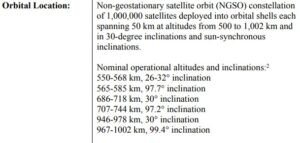
The Federal Communications Commission has approved SpaceX’s request to place up to one million satellites in low Earth orbit to operate as orbital data centers. FCC Chairman Brendan Carr announced the decision on November 25, 2026. The constellation, called Starmind, would come on top of the roughly 42,000 Starlink broadband satellites SpaceX plans to deploy and the military-oriented Starshield network. Astronomers, space sustainability groups and others have warned about collision risk, reentry effects on the atmosphere and interference with astronomy.
Deployment deadlines
The FCC assigns spectrum to commercial operators so their systems do not interfere with one another. It also sets milestones so that licensees cannot hold frequencies without building out their systems. Under the Starmind approval, SpaceX must meet the following schedule:
- one satellite in orbit by November 25, 2033;
- the first 10 percent of the constellation by November 25, 2035;
- 50 percent by November 25, 2038; and
- the full constellation by November 25, 2040.
The approval allows six operational altitude and inclination combinations. Carr announced the decision on X, and Elon Musk replied that the system would benefit the United States and the world.
A crowded field of orbital data centers
SpaceX disclosed its plan for one million orbital data centers (ODCs) in January. Other companies are pursuing similar concepts, drawing on the near-continuous sunlight available in space to power computing hardware. The Secure World Foundation tracks nine such companies and the number of satellites each expects to launch. Five are American and will need FCC approval for the radio links between ground and orbit. Carr referred to these competing constellations in his announcement, but SpaceX’s is the only application approved so far.
An ODC performs much the same function as a terrestrial data center. It needs no water for cooling, since the cold of space serves that purpose. Solar arrays provide power, and satellites in Sun-synchronous orbits can have constant access to sunlight.
Astronomers and policy experts raise concerns
The American Astronomical Society said it was disheartened and dismayed by the decision. It argued that the approval would significantly undermine decades of federal investment in astronomical facilities, along with the ability of both astronomers and the public to study and enjoy the night sky. The society said the FCC should weigh protection of optical and infrared astronomy when reviewing satellite applications, because no other licensing agency can take those concerns into account. It added that American technical innovation in space should not come at the expense of scientific research.
In its ruling, the FCC said that environmental and astronomical impacts fall outside its jurisdiction.
Secure World had filed public comments on the ODC proposals. It described the current wave of applications as a qualitative shift in the scale of proposed constellations and called for a technical review that goes beyond spectrum interference. It asked regulators to consider the environmental effects of higher launch rates, the atmospheric impact of large numbers of satellites reentering at end of life, and the cumulative effects on dark and quiet skies and on optical and radio astronomy.
Orbital traffic rules remain unsettled
Collision risk is a further concern when so many satellites share similar orbits. Operators can use “dawn-dusk” or “dusk-dawn” orbits, in which satellites cross the equator at 6:00 a.m. and 6:00 p.m., or the reverse, to keep their solar panels in sunlight. No global “Rules of the Road” agreement yet says whether all of these satellites should follow one direction or the other.
At a Secure World event on July 29, 2026, participants worried that government regulation would not arrive quickly enough. Matias Cava of the Commerce Department’s Office of Space Commerce urged operators to adopt responsible practices now, modeled on the behavior they would want from their competitors.
Source: spacepolicyonline.com