Two satellite operators say they will build their own rockets, a sign of how tight launch capacity has become. AST SpaceMobile and Cowboy Space both announced vehicles in recent weeks, each targeting a first launch as soon as 2028. Neither has detailed a development schedule or cost, and both face large technical and logistical hurdles.
A constrained launch market
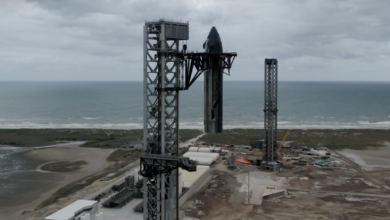
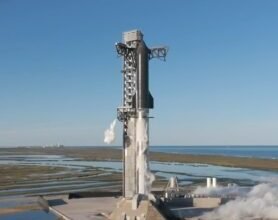
The announcements come as options shrink. SpaceX is phasing out its Falcon 9 for commercial missions, and there is a growing belief that Starship will be used mainly for SpaceX’s own payloads. SpaceX did catch a Starship upper stage, Ship 42, at its Starbase launch site on Saturday after the Flight 15 mission. It has not yet reflown a ship, and it again failed to catch the Super Heavy booster.
Less than 24 hours later, a ULA Vulcan failed on its first flight in nine months. ULA reported an anomaly about ten minutes into the mission, though telemetry suggests the problem began earlier, during the first-stage burn. Blue Origin’s New Glenn has been grounded since a pad explosion in May, and its return to flight has slipped to early next year.
AST SpaceMobile’s Blacklift
AST builds low Earth orbit satellites with large phased-array antennas that provide broadband directly to mobile phones. Its production line is in Midland, Texas. New Glenn can carry up to eight BlueBird satellites, but an upper-stage problem on its previous flight left the single BlueBird aboard in an orbit too low to recover from. AST now relies on Falcon 9, which carries three per launch.
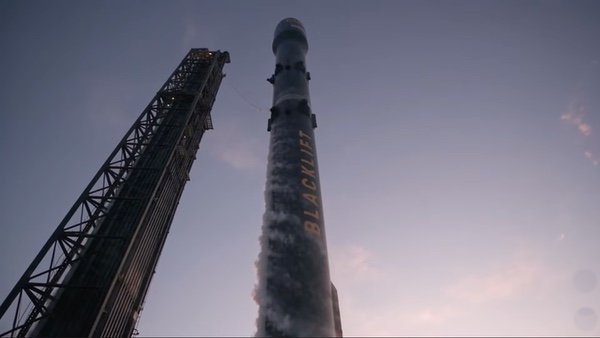
On November 6, AST announced Blacklift, a vehicle that would use engines from Firefly Aerospace. The $1.3 billion agreement covers $800 million for a license to manufacture the engines, $250 million for Miranda and Vira engines for the first three vehicles, and $250 million in engineering services. Firefly CEO Jason Kim said the money would help ramp up engine and vehicle production and speed development of its own medium-class Eclipse rocket. Blacklift is intended only for AST’s satellites.
The rocket would lift up to 20 tons to low Earth orbit, enough for five BlueBirds. AST CEO Abel Avellan said it would have three stages, unusual for a low Earth orbit vehicle, and use carbon composites. He said the three-stage design would make booster reuse easier. The first set of ten composite tanks is due for testing in January in Midland. Large composite structures can be hard to build, as Rocket Lab found when problems with Neutron’s first-stage tanks pushed that rocket’s debut into 2027.
The November 12 unveiling in New York showed only animations and engine videos, not hardware. The launch site is also unsettled. AST has said it would use the former Antares pad at Wallops Island, Virginia, but a Virginia Spaceport Authority spokesperson said preliminary talks with AST specifically excluded that pad, known as Pad 0-A. The authority said AST could instead redevelop Pad 0-B or build a new pad, both of which would take significantly more time and money.
Cowboy Space and Big Iron
Cowboy Space, formerly Aetherflux, moved from space-based solar power to orbital data centers this year. At an event in late October, it unveiled Big Iron, which would place 15,000 kilograms into Sun-synchronous orbit. The upper stage doubles as the payload. Once in orbit, it deploys solar arrays and radiators to support racks of Nvidia processors.
Unlike AST, Cowboy Space is developing its own engine. The reusable stainless-steel first stage would use nine Clydesdale engines, each producing 300,000 pounds-force of thrust on liquid oxygen and methane. Testing has begun on the gas generator, a component that drives the turbopumps. Full-engine tests are expected next summer. CEO Baiju Bhatt, founder of Robinhood, said a late-2028 first launch is possible but not guaranteed.
The company has not given a development cost. It raised $275 million earlier this year, a small share of what a new vehicle is likely to require. It also proposed “Trailhead” sites that would combine production with five launch pads, mostly in places that support Sun-synchronous launches.
Big Iron’s purpose is to deploy Stampede, a constellation for which the company has filed plans for up to 20,000 satellites. Launching them one per flight over five years would require about 11 launches a day. Cowboy Space, unlike AST, says it will offer Big Iron to other customers.
Both timelines are aggressive. Neutron was announced in 2021 for a 2024 debut and has yet to fly, and multi-year slips are common for new vehicles.
Source: www.thespacereview.com