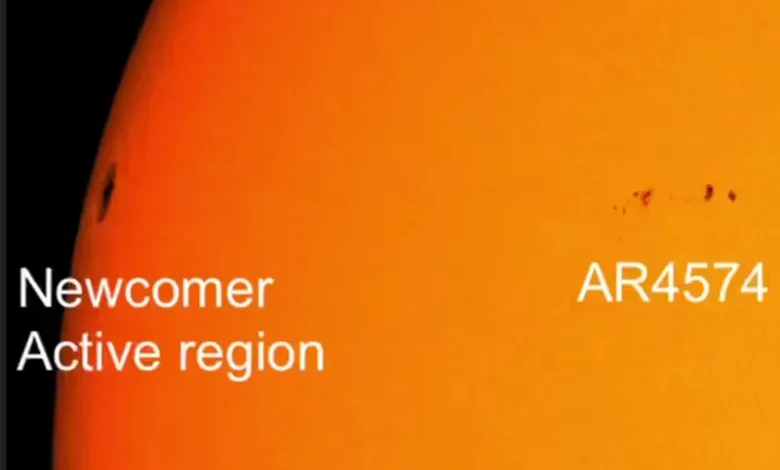
A large, still-unnumbered sunspot region is rotating onto the Earth-facing side of the sun over its northeast limb, and it has already produced the strongest flare of the latest reporting period. The region fired a C5.5 flare that peaked at 18:21 UTC on November 13. It arrives as AR4566, the dominant sunspot group of the past two weeks, slips out of view over the southwest limb.
A changing of the guard on the solar disk
Eight numbered sunspot regions currently sit on the sun’s Earth-facing hemisphere, according to the 24-hour summary covering 11 UTC November 13 to 11 UTC November 14. Only a small part of the newcomer is visible so far, but it already appears large next to the smaller groups scattered across the disk. It has no official number yet.
The sun produced 11 flares in the period, 10 of them C-class and one B-class, keeping overall flare activity low. Beyond the C5.5, AR4568 fired a C4.4 despite simplifying from a beta to an alpha magnetic configuration. AR4576 added a C1.3. AR4578, a southwestern region that developed quickly into a beta configuration, produced five of the 11 flares, more than any other numbered region. AR4577, a newly numbered region in the southeast, was quiet.
No Earth-directed coronal mass ejections were found in available coronagraph imagery from SOHO or other sources.
AR4566 bows out
AR4566 gave the week much of its activity. On November 10 it was the largest and most magnetically complex group on the disk, carrying a beta-gamma-delta configuration, the most complex classification, which signals potential for M-class or X-class flares. It produced three M-class flares between November 7 and 8, another on November 8, and an M1.7 on November 11 that caused a minor R1 radio blackout over the South Pacific near Easter Island.
The region then decayed. It lost its delta complexity by November 11 and was down to a beta configuration by the latest report, with no flares in the most recent period. Its position at the limb makes a full analysis difficult.
Forecast: quiet, then a fast stream
Forecasters expect flare activity to slow through November 15. The chance of C-class flares holds at 90% for November 14. The chance of M-class flares has dropped to 25% from 35% the day before, and the X-class probability remains at 5%.
Space weather was calm over the past day. Solar wind speeds stayed low on average, and geomagnetic conditions were very quiet, with Kp index values of 0 to 1. The interplanetary magnetic field was weak, and its north-south component swung most strongly northward, so little solar wind energy coupled into Earth’s magnetosphere.
That is expected to change on November 16. A high-speed stream from a new, Earth-facing coronal hole should begin arriving, and forecasters expect unsettled conditions with isolated active periods. Mostly quiet conditions are forecast for November 14 and 15.
An earlier coronal hole stream drove the recent aurora activity. It pushed solar wind speeds to a peak near 814 km/s and produced G1 (minor) geomagnetic storm conditions, with auroras seen as far south as northern Minnesota. That coronal hole has since rotated out of view on the southwest limb.
Source: earthsky.org