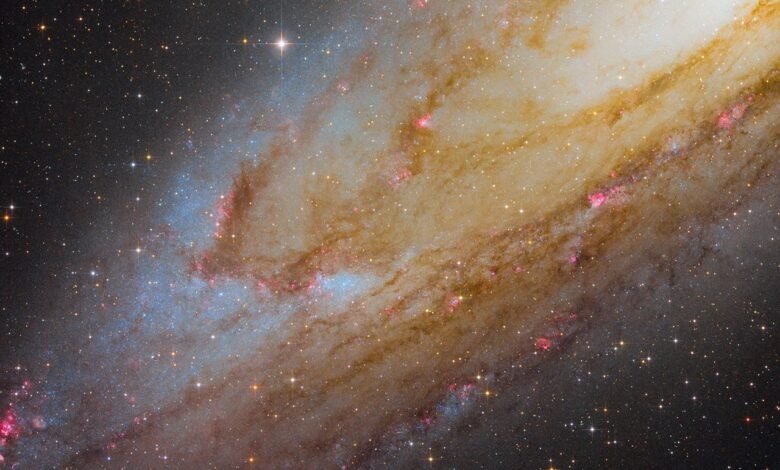
NGC 206, a large stellar association embedded in the dusty spiral arms of the Andromeda galaxy (M31), appears at the center of a detailed close-up of the southwestern part of Andromeda’s disk. Its bright blue stars mark it as a young population, and its size sets it apart from the star groupings found in our own galaxy.
A young, extended star group
The blue color of NGC 206 points to recently formed, massive stars. According to the image description, the youngest of these stars are less than 10 million years old, a short span in astronomical terms. The association sits among the dust lanes of Andromeda’s disk, alongside the galaxy’s pinkish star-forming regions.
Andromeda is a neighboring spiral galaxy about 2.5 million light-years from Earth. That distance still allows astronomers to pick out individual features such as NGC 206 within its disk.
How it compares
NGC 206 spans roughly 4,000 light-years, which makes it much larger than the open or galactic clusters of young stars found in the disk of the Milky Way. Those clusters are compact by comparison, while NGC 206 is a sprawling association of stars.
Its dimensions are closer to those of some of the largest known stellar nurseries in the Local Group neighborhood. The description names two of them: NGC 604 in the nearby spiral galaxy M33, and the Tarantula Nebula in the Large Magellanic Cloud. Their sizes are comparable to that of NGC 206.
The image shows the association in the context of its surroundings, with the dust and star-forming regions of Andromeda’s disk around it. The next featured picture in the series will show pixels on the Moon.
Source: science.nasa.gov