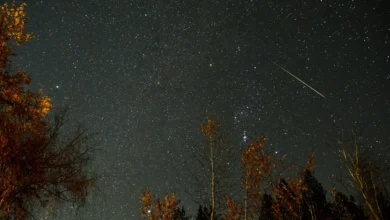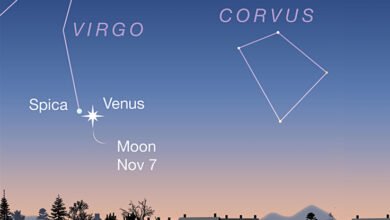
The Leonid meteor shower is expected to peak at 0 UTC on November 18, 2026, according to the American Meteor Society. Moonlight will not get in the way this year. Observers under dark skies should see roughly 10 to 15 meteors per hour at best, and scientists do not expect a Leonid meteor storm.
When and where to watch
The best viewing falls between midnight and dawn on the mornings of November 17 and 18. The first quarter moon occurs at 11:48 UTC on November 17 and sets around midnight, leaving the pre-dawn sky dark. Peak times can shift, so the predicted timing is an estimate rather than a fixed schedule.
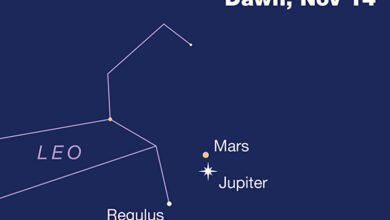
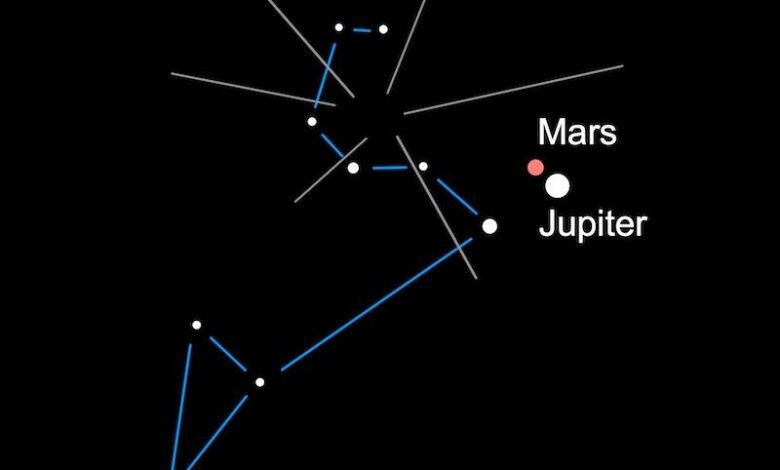
Leonid meteors appear to radiate from a point in the constellation Leo, the Lion. That radiant rises around midnight and stands highest at dawn, and more meteors typically appear once it has cleared the eastern horizon. Observers do not need to look directly at it, because the meteors show up all over the sky.
This year, Jupiter and Mars can serve as markers. The two planets sit near the radiant, separated by about two full-moon widths. Observers under a dark sky can also look for the Sickle, the backwards-question-mark pattern of stars in Leo.
Earth crosses the Leonid stream from October 28 through December 7, so occasional Leonids are possible outside the peak nights.
A shower known for its storms
The Leonids’ reputation rests on rare outbursts rather than their ordinary rates. Most astronomers define a meteor storm as more than 1,000 meteors per hour. The November 12–13, 1833 storm, sometimes called the Night the Stars Fell, is widely estimated to have reached up to 150,000 meteors per hour.
On the morning of November 17, 1966, observers in the southwestern United States reported up to 70 meteors per second over a span of 15 to 20 minutes. The 1999–2001 showers also produced high rates. Observed peaks reached about 3,700 to 4,000 per hour in 1999, about 130 to 480 per hour in 2000, and a double peak in 2001 of 1,500 to 2,000 per hour, then 3,000 to 3,700 per hour.
Storms have tended to recur on cycles of 33 to 34 years, though not reliably. The 1899 storm failed to appear despite high expectations, which many astronomers considered a severe blow to astronomy’s public standing.
Comet 55P/Tempel-Tuttle
The shower’s parent body is Comet 55P/Tempel-Tuttle. Wilhelm Tempel of Marseille Observatory discovered it on December 19, 1865. Horace Tuttle of Harvard College Observatory independently found it on January 5, 1866, and his name was added to the comet. Measurements from that appearance gave an orbital period of 33.17 years, and astronomers soon linked the comet to the 1833 storm and to the annual mid-November showers.
Observers missed the comet in 1899 and 1932, and it was recovered in 1965 at 16th magnitude, visible only in very large telescopes. The 1966 storm followed. On its next return in early 1998 the comet was bright enough to see in binoculars, and the enhanced meteor activity of 1999–2001 followed. The comet is due back in early 2031.
Fireballs, or very bright meteors, can be reported to the American Meteor Society.
Source: earthsky.org