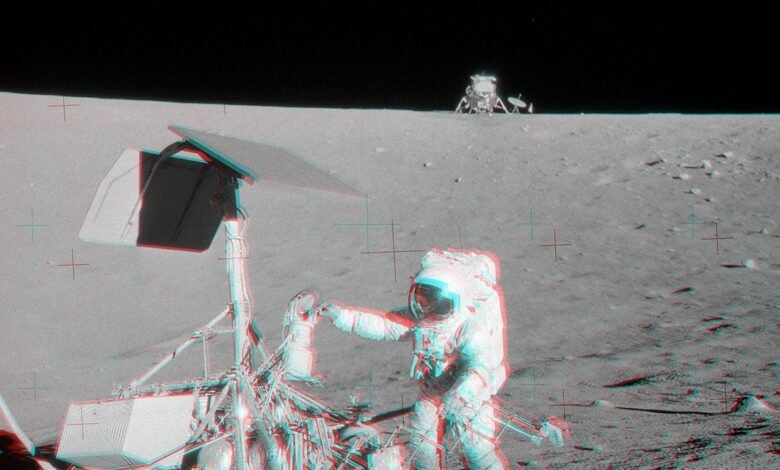
A 3D anaglyph built from two Apollo 12 surface photographs shows astronaut Pete Conrad at the Surveyor 3 spacecraft in the western Oceanus Procellarum, or Ocean of Storms, in November 1969. Viewed with red/blue glasses, the image reproduces the depth of a scene that connects a robotic lander with a crewed one on the same patch of lunar ground.
Two landers, one crater
Surveyor 3 touched down in April 1967, roughly two and a half years before Conrad walked up to it. The uncrewed spacecraft came to rest on the inside slope of a small crater. Apollo 12’s Lunar Module, Intrepid, later landed less than 200 meters (650 feet) away. That put the older spacecraft within easy walking distance for the astronauts.
Intrepid is visible on the horizon in the image, beyond the far wall of the crater. The scene shows how close the Apollo 12 crew set down to their target, and why the robotic probe was reachable on foot.
How the stereo image was made
The anaglyph was assembled from two separate frames taken on the lunar surface, catalogued as AS12-48-7133 and AS12-48-7134. The pictures show the scene from slightly different positions, a separation comparable to the distance between a person’s eyes. Combining them in separate color channels lets each eye receive a different view, and the brain interprets the difference as depth.
The result gives a sense of the crater’s slope and of the spacing between Conrad, Surveyor 3 and the distant lander. A single flat photograph would not convey that spatial relationship as well.
The image was presented as an astronomy picture of the day, with a note that the next feature would show meteors passing through the constellation Orion.
Source: science.nasa.gov