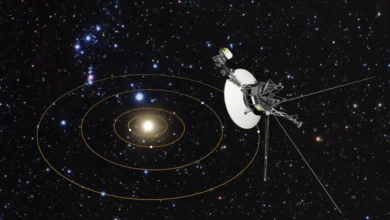
NASA’s Voyager 1 will reach a distance of one light day from Earth on November 18 at 5:16:07 a.m. EST (10:16 UTC). It is the first spacecraft to get that far. To mark the occasion, the agency is asking the public to send a symbolic signal toward the probe the evening before.
What a light day means
A light day is the distance light travels in 24 hours: 25,902,068,356 kilometers, or 16,094,799,096 miles. Voyager 1 has taken almost 18,000 days to get there. It launched 49 years, two months and 12 days ago and now travels at about 17 kilometers per second.
The figure also offers a way to explain interstellar distances to general audiences. At its current speed, Voyager 1 would need roughly 75,000 years to reach Proxima Centauri, but only if it were aimed at that star. The spacecraft is actually heading toward the constellation Ophiuchus, so the Proxima comparison is only an illustration.
A more precise estimate would need two corrections. The Sun’s small residual gravitational pull will keep slowing the probe, eventually bringing its cruising speed down to 16.6 kilometers per second. And Alpha Centauri is moving toward the Sun, which will make it considerably closer than it is now in about 20,000 years. Even so, the 75,000-year figure remains a reasonable approximation.
‘Shine Bright for Voyager’s Light Day’
NASA’s public effort, called “Shine Bright for Voyager’s Light Day,” asks people to go outside after sunset on November 17 and flash the mission’s call sign, “VGR,” in Morse code. Participants can use an automated flasher NASA has made available for smartphones, or a plain flashlight. NASA has posted online directions for signaling by flashlight.
The agency describes the event as symbolic. It recognizes the work needed to send Voyager so far from Earth and serves as a reminder that both Voyager spacecraft are still functioning.
A precedent in fiction and in orbit
The idea of lights acknowledging a distant traveler has a history in both fiction and spaceflight. James Gunn’s short story “The Cave of Night” appeared in Galaxy Science Fiction in February 1955. It was later reprinted, adapted for the radio series X Minus One and dramatized on television in 1959 as “Man in Orbit” on Westinghouse Desilu Playhouse. In that version, an astronaut stranded in orbit cannot receive communications, so people on Earth flash their lights in synchronized fashion to show his transmissions are being heard.
A comparable gesture took place in reality in 1962, when residents of Perth, Australia, greeted astronaut John Glenn with lights as he passed overhead. Glenn’s situation was far less dire than the fictional astronaut’s.
Gunn wrote the story as public interest in spaceflight was rising, shortly after Collier’s published a series on humanity’s future in space featuring Wernher von Braun. That was well before Yuri Gagarin’s first orbital flight. Gunn’s story is available in several anthologies, including Judith Merril’s SF: The Year’s Greatest Science Fiction and Fantasy (Dell, 1956) and his own collection Station in Space (Bantam, 1958).
Source: www.centauri-dreams.org