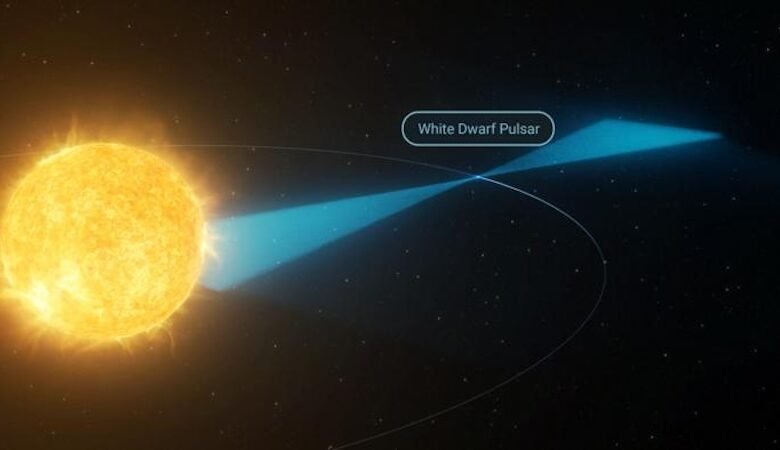
Astronomers have identified the origin of a radio signal that pulses every eight minutes: a white dwarf orbiting a sun-like star. The system, GPM J071507-114153, is the first long-period transient confirmed to have a sun-like companion. Researchers at the International Centre for Radio Astronomy Research (ICRAR) in Australia say the pulses come from the white dwarf, which rotates once every eight minutes. They published their peer-reviewed results in Nature Astronomy on November 12, 2026.
The signal is not technological in origin. It comes from a binary pair of stars, and the system is unusual. Most pulse-emitting systems of this kind contain red dwarf companions, which makes a sun-like partner a first.
A puzzle in long-period transients
GPM J071507-114153 belongs to a class called long-period transients (LPTs). These objects emit radio pulses that switch on and off over periods of minutes to hours. The first was found in 2021, and roughly a dozen have been identified since. Several of them contain a white dwarf, but it had been unclear which star in each binary was producing the radio emission.
For this system, the team traced the source to the white dwarf itself or to a region close to it. The analysis involved more than 100 hours of radio data processed at the Pawsey Supercomputing Research Centre.
Sam McSweeney of the Square Kilometre Array Observatory (SKAO), the study’s lead author, said the pulses were clear enough for the first time to show the white dwarf moving in its orbit around its companion. That motion is what allowed the team to place the emission near the white dwarf.
Using the pulses to probe a stellar atmosphere
The radio pulses also served as a probe of the companion star. The researchers used them to detect eruptions on the sun-like star, similar to those seen on our own Sun. Co-author Natasha Hurley-Walker of ICRAR said the team saw the white dwarf move behind a region with a strong magnetic field, most likely a stellar prominence, a large loop of plasma erupting from a star’s surface.
She noted that radio observations make it possible to detect storms on a star more than 5,000 light-years away.
Found in a Milky Way survey
The system turned up in a large survey with the Murchison Widefield Array (MWA), which scanned the entire portion of the Milky Way visible from Australia. The MWA is a precursor instrument to the SKAO telescopes.
The researchers expect more binaries like this one to be found. McSweeney said that if precursor telescopes can already make such discoveries, the completed SKAO telescopes should reveal many more systems and show their signals in far greater detail.
Source: earthsky.org