The final full week of November 2026 brings several observable events: the Full Moon passes in front of the Pleiades, Uranus reaches opposition, and Comet 161P/Hartley-IRAS arrives at perihelion. Most can be seen with binoculars or a small telescope, and the Pleiades occultation needs no optical aid.
Full Moon covers the Pleiades
Full Moon occurs at 9:54 a.m. EST on November 24. It is the year’s second Super Moon, meaning the Moon becomes full close to perigee. The November Full Moon is also known as the Beaver Moon. Perigee follows on November 25 at 4:01 p.m. EST, at a distance of 223,288 miles (359,347 km).
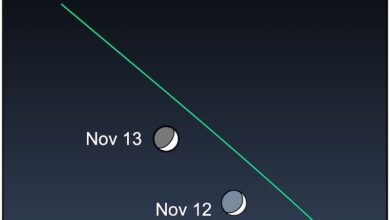
Before dawn on the 24th, the Moon moves through the Pleiades (M45) in Taurus and occults several of the cluster’s bright stars. Timing depends on location. Along the East Coast the event begins around sunrise, so observers there may see only the Moon approaching the cluster.
For Central time observers, 5th-magnitude Celaeno (16 Tauri) vanishes just before 6 a.m. CST. Taygeta (19 Tau) follows minutes later, then Maia (20 Tau) just before 6:20 a.m. and Sterope (21 Tau) a few minutes after that. The last two may be hard to catch without optical aid as sunrise nears. Celaeno reappears around 6:40 a.m. CST, roughly 15 minutes before sunrise. Observers using binoculars or telescopes should put them away several minutes before the Sun rises. A Moon filter is advisable, and the International Occultation Timing Association publishes location-specific timings.
Later that day the Moon passes 5° north of Uranus at 2 p.m. EST, and Mars passes 1.8° north of Regulus in Leo at 5 p.m. EST.
Uranus at opposition
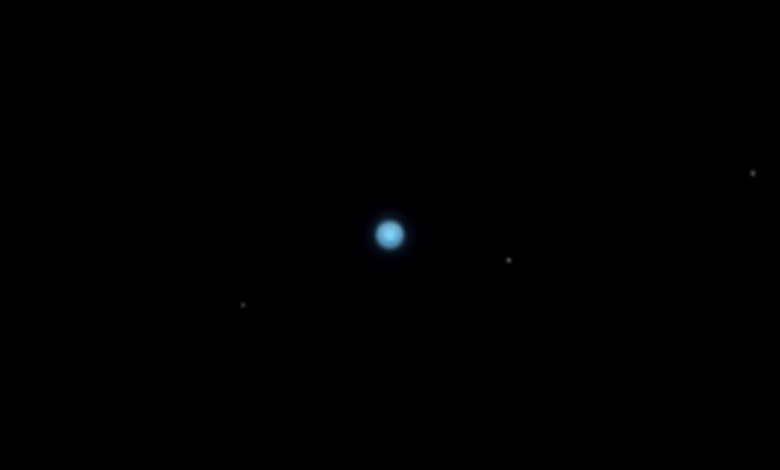
Uranus reaches opposition at 6 p.m. EST on November 25, when it is visible roughly from dusk until dawn and best placed for viewing. At magnitude 5.6 it can be seen with the naked eye under dark, clear skies, but the bright waning Moon nearby makes binoculars or a telescope the better choice.
Waiting a few hours after sunset lets the planet climb above horizon haze. Around 10 p.m. local time, Uranus sits about 60° above the southeastern horizon in Taurus, midway between Aldebaran and the Pleiades and about 1.5° south of 4th-magnitude 37 Tauri. Its 4-arcsecond disk should look like a flat, grayish star rather than a pinpoint.
Comet 161P/Hartley-IRAS
Comet 161P/Hartley-IRAS reaches perihelion on November 27, the closest point to the Sun in its 21½-year orbit. It has held fairly steady at 10th to 11th magnitude. It has no appreciable tail, though recent astrophotos show a green glow around the nucleus.
A few hours after sunset the comet is in the west, about 30° high near 7 p.m. local time. It lies in western Sagitta, roughly 6.3° north-northeast of Zeta Aquilae. A 4-inch telescope will show it, and larger apertures may reveal detail near the nucleus, such as a sharpened southern flank. About 2.1° northeast sits the Coathanger asterism in Vulpecula.
Mercury, the Moon and Orion
Mercury reached greatest western elongation, 20° from the Sun, on November 20. On the morning of the 21st it stands 7° high about an hour before sunrise, at magnitude –0.5 in Libra. It lies far to the lower left of Venus, which is in Virgo near Spica. In a telescope Venus spans 46 arcseconds but is only 19% lit, while Mercury is 7 arcseconds across and 62% lit. Mercury’s phase should reach 84% by the end of the month.
On November 22, telescope users can look at Schickard near the Moon’s southwestern limb. The crater is about 130 miles (210 km) across and roughly 4 billion years old, and lava flooded most of its floor but not the southwestern part. On Thanksgiving evening, the Orion Nebula (M42), about 1,350 light-years away, is easy to find in binoculars below Orion’s Belt.
Source: www.astronomy.com